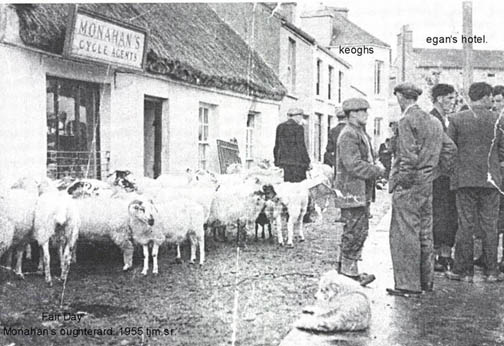
Early Years in Oughterard
I spent my childhood in Oughterard, a small town where the spirit of community was ever-present and unwavering. Our family lived in a modest one-bedroom rental, and despite the limited space, my parents, my three siblings, and I found warmth and joy together. The heart of our home was the kitchen, situated directly beneath our bedroom. It was a place alive with laughter and togetherness, where the absence of material possessions was more than compensated for by the closeness and strength of our family bonds.
Our rented house was located on Main Street and adjoined a larger home owned by Mrs. Harris, a widow with two children, Mary and Michael, who quickly became my close friends. Over time, the house changed hands, eventually purchased by William Keogh. His son, Johnny, transformed part of the property into a drapery shop. Today, that same space is occupied by Henry Keogh’s gift shop, renowned for Henry’s generous smile, his kind heart, a wide variety of merchandise, attractive discounts, and swift customer service.
My father enjoyed his pints of Guinness, and my mother frequently tried—though rarely succeeded—to limit his drinking. His evenings were often spent at Powers’ local pub or at Madam McCarthy’s, a two-story thatched pub where the Boat Inn now stands. These establishments served as the social heart of the town, where men gathered to share stories and enjoy one another’s company. Despite this routine, my father was a diligent worker, always searching for odd jobs, often paid with promises of “I’ll pay you next week,” which seldom materialized. Eventually, he gave up drinking altogether and played a pivotal role in founding the Pioneer Association in Oughterard, supporting others who faced similar struggles.
Our evenings at home revolved around the fire, which we fueled with sticks and turf. My brother and I would venture into the woods, gather bundles of sticks, tie them together with rope, and carry them home. On one occasion, after collecting two loads, we were caught by the woodland owner and forced to leave our bundles behind. That night, our house was cold. My father’s advice was simple yet memorable: “Next time, be smarter than her and don’t get caught.”
Oughterard was known for its friendliness and trustworthiness. Neighbors welcomed each other with open doors and the familiar invitation, “Come in; the door is not locked.” Visitors would step inside, offer a blessing, and be invited to sit by the fire and share a meal. The town’s location along the main road between Galway City and Clifden made it a lively and bustling place.
One memorable story my parents told involved a bus stopping outside our house as a voice shouted, “Don’t move! That Monahan brat kid is under the bus!” I had crawled beneath the bus, cleverly evading every attempt to coax me out, delaying its departure for nearly an hour. As I grew older, I became known for helping others, often driving my father’s old car around town—without a license—giving rides to anyone in need. These escapades helped me learn about engines and car repairs. At sixteen, I bought a motorcycle and rode it up and down Main Street at night, much to the concern of residents worried about their hatching hens.
My reputation as a mischief-maker grew. I earned the nickname “the Monahan brat kid” through my pranks, such as tying black thread to a doorknocker to pull it from across the street or placing a wet burlap sack on a chimney to fill kitchens with smoke. My antics were notorious but harmless, and the name stuck.
Among our neighbors was Johnny Halloran, the local tailor. I enjoyed watching him craft suits, and he would give me empty spools of thread to use as spinning tops. I sharpened one end, inserted a hobnail, and used a shoelace tied to a hazel rod as a whip. As I spun my top on the way to school, other kids would often ask me to make one for them. I shared mine and made new ones for myself, embodying the spirit of sharing. Camp Street was home to Micky Reilly, the shoemaker, famous for the rhythmic sound of his hammer and his step dancing, as well as Paddy Tom Joe, the blacksmith, who occasionally let me operate the bellows.
After Johnny the tailor passed away, an American woman and her brother bought his house. With Tommy Dixon’s help, they built a two-story home called Small Jimmies, which included a sweet shop. After dances, boys and girls would gather there, buying ice cream for their sweethearts and dreaming of inheriting farms or moving to big cities like New York, Boston, or Chicago.
Across from our house stood the Power family’s thatched pub and home, which remains to this day. I spent many hours with John Power, sitting on the stone bench outside, watching people pass by on Main Street. As I prepared for my confirmation, Jerry Power helped me memorize catechism answers, rewarding perfect recitations with a half crown.
Mick Keogh was a guiding figure, working to keep local boys out of trouble by starting a drama society and encouraging us to perform plays during Lent. Social events at dance halls like Sullivan’s and Kirk Hall were highlights of our youth, and it was there that I became a skilled dancer—a talent that has stayed with me throughout my life. Many people met and married the partners they met on the dance floor.
Mrs. William Keogh enjoyed playing poker and often invited me to join her in her kitchen, where we played for matchsticks. Her kitchen felt like a second home. Two Keogh brothers entered the priesthood: Father Joe, who admitted to my mother that his hands trembled with nerves at his first Mass, and his brother Hon, who bestowed blessings upon us all. My visits back to Ireland, two or three times a year, always included a stop at Henry Keogh’s store for a warm greeting. The people of Oughterard taught and guided me throughout my childhood, always looking out for each other—a quality I wish existed everywhere.
I eventually traveled to New York City, where, thanks to my father’s teachings, I became a plumber and started my own business. Friends from my youth followed their own paths: Terry Watts became a sheriff in Florida, and Mick Connors became a well-known musician. At twenty-two, I arrived at Idlewild Airport, uncertain if I could achieve my dreams in such a vast city. The adjustment was challenging, and I found work operating an elevator in a department store on 42nd Street, earning money to send home. Many Irish people I met in New York called me a greenhorn. I recall riding an elevator when the operator—a witty Irishman—called out, “Me lad, did you have shoes when you came here?” Though the question stung, I replied, “I did, but they were my brother’s, and I intend to send them back to him one day.”
I spent my life in America, fortunate to have built a good life for myself, my wives, and my children. I owe all my success to the foundation laid during my childhood in Oughterard.









No Comments
Add a comment about this page