Henry Michael Ferriss
DFC Battle of Britain hero
Gerard Ferris, a first cousin once removed of Henry Michael Ferriss.
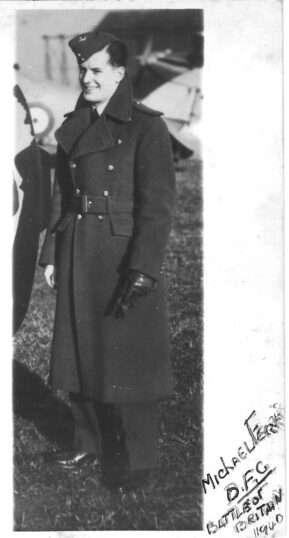
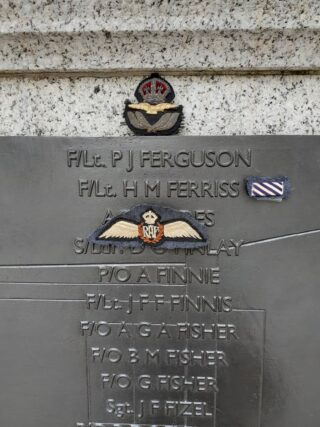
His obituary was printed in the December 1940 edition of The Stonyhurst magazine when he was just 22 years of age. The full story of his flying career has now been specially written for The Stonyhurst Record by Gerard Ferris, whose father was a cousin of Henry Michael but on the side of the family that no longer uses an extra ‘s’ in the surname.
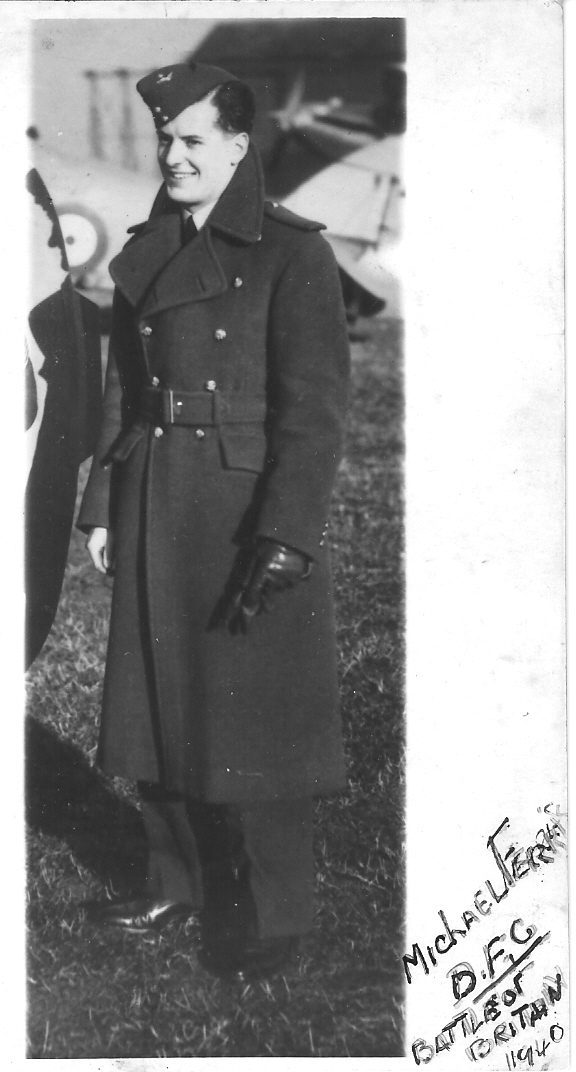
Henry was born in 1918, but as his father was also called Henry he has always been known in the family as Michael. He entered Stonyhurst on the 23rd of September 1930 and left on the 30th of July 1934. In those four years he managed to make his mark in the Corp of Drums which won the Camp Band Competition at Tidworth Pennings and at Strensall in 1933 and 1934. He was also in the school Choir and played the violin in the Orchestra.
Stonyhurst gave him an introduction to the Air Training Cadets, and he learned to fly at the London University Air Squadron where he gained his A-certificate at the age of only 17. Financial pressures of the 1930’s meant his father’s pharmacy business was unable to support his medical studies at St. Thomas’s Hospital in London so he applied for a short Service Commission in the Royal Air Force. On 7th of May 1938, after passing out ‘first’ from his flying school, he joined the soon to be famous 111 Squadron which had been formed in Palestine on 1st August 1917.
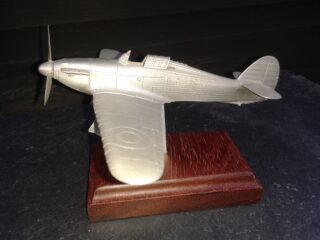
In December 1937, 111 Squadron became the first RAF unit to take delivery of the advanced eight-machine gun armed Hurricane fighter. In this Squadron with their new fighters, Michael Ferriss wrote his name into history in the Battle of Britain as one of ‘The Few’. With a starting rank of Acting Pilot Officer he spent the rest of 1938 and the first five months of 1939, doing cross-country and night time flying. He also practiced his notable aerobatic skills for participation in Empire Day celebrations and flying demonstrations for French, Arab and Parliamentary visiting delegations. But from June 1939 flying concentrated more on air interception exercises in readiness for war.
On 3rd September 1939, when Prime Minister Neville Chamberlain announced at 11am on a radio broadcast: ‘We are now at War with Germany’, Michael was one of four established Pilot officers with the Squadron. On this day the operational Status of 111 Squadron was ‘Available, Ready or on Patrol’. As preparations for the war continued, with the threat of a German invasion, Michael found himself, in October, firing 1,562 rounds to shoot down one of the eleven barrage balloons which had broken loose.
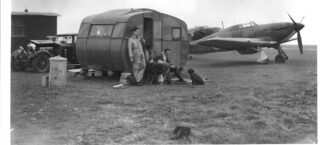
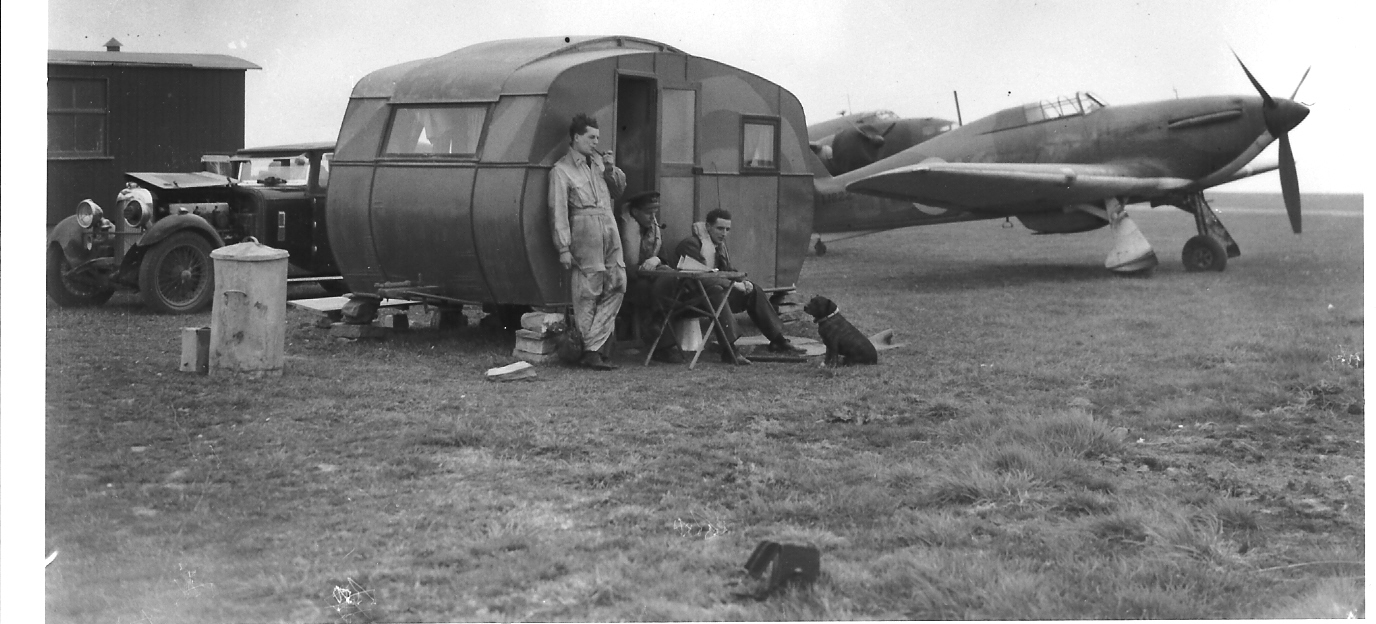
In January 1940, he was promoted to Flying Officer Air patrols, Interception Flights, Anti-Aircraft and Search-Light Unit co-operation exercise continued with the Squadron being moved to bases around the East Coast of the UK. In February 1940 the Squadron flew to a posting at Wick airfield in Scotland. It was here at the end of the month that a series of photographs were taken of Michael with two other pilots, a Hurricane and an old civilian caravan.
These photographs frequently appear in RAF and Battle of Britain books and even as a montage on a jigsaw titled To the Victor by an American artist but is very rare for the Pilots to be identified by name.
On the 8th of April 1940 a night attack was made by 255 enemy bombers on Scarpa Flow. All of the 111 Squadron participated in attacking the enemy force. Michael claimed a half share in a ‘probable’ kill while the Squadron as a whole claimed four enemy bombers as definitely destroyed. Two days later Michael had a further share in a ‘probable’ kill of a Heinkel He-111 bomber.
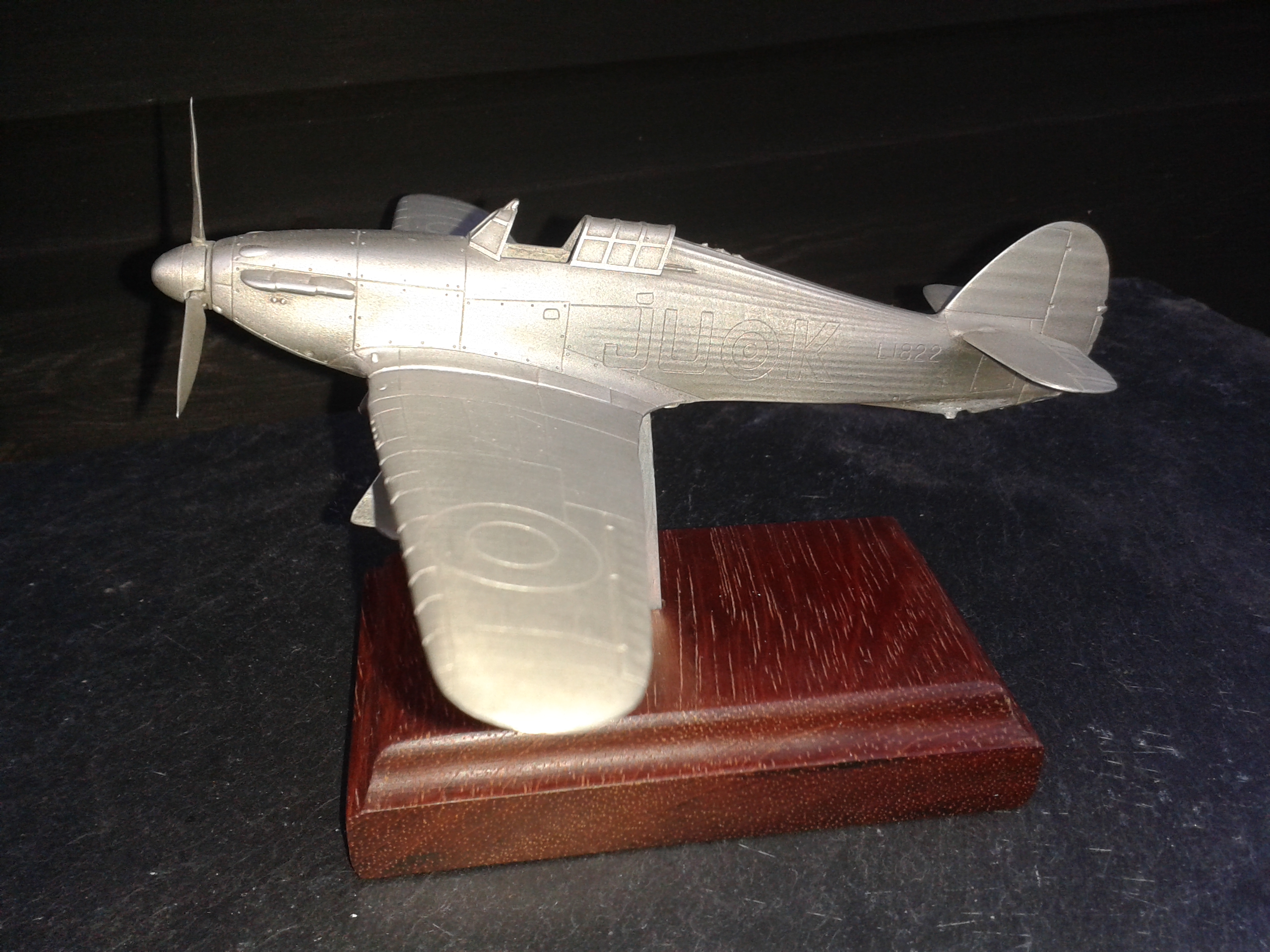
In May 1940 Michael was with the Squadron making patrols over Northern France using airfields in the South of England. On 18th of May in the Hurricane L1822 shown in the ‘caravan’ photographs, he is credited with shooting down at least three and probably a fourth enemy Messerschmitt Me-110e over France. Rarely on either side during the War did air crew admit to shooting at enemy air men on their parachutes. But such was Michael’s honesty that he admitted to shooting at the two crew of one of the Me-110 since they were descending over enemy-held territory. On this day one of his fellow pilots was killed with two more getting killed in combat the next day, one quite literally being shot to shreds on his parachute by a German fighter.
On the 31st of May, Michael was leading ‘Yellow’ section (a section being a group of three fighters) when over Dunkirk he shot down a Me-109 fighter which was on the tail of a Spitfire. On 21st June, an official announcement stated that he had been awarded a Distinguished Flying Cross for destroying at least seven enemy aircraft where ‘in these combats he displayed outstanding ability’.
Patrols and interceptions continued, and on 10th July 1940, the day history has decided that the Battle of Britain started, Michael had a most daring encounter. With the Squadron vectored to intercept enemy aircraft bombing shipping off Folkstone they encountered 24 Dornier bombers. Michael joined the attack on one of them before spotting an Me-109 which he chased out to sea. In his own words ‘I gave him four sharp bursts and suddenly his port wing dropped. His starboard wing went up and then in a flash his nose went down; he was gone. He simply vanished into the sea.’ At that moment Michael was attacked by three Me-109s, resulting in damage to his port aileron and a wound to his leg. Being virtually out of ammunition he made a dramatic evasive flight home which used to the full his flying abilities and calmness. Once back at the coast his attackers themselves turned for home. Three days later Michael made a broadcast on BBC Radio describing this combat. His recording can be heard today on a CD entitled ‘FIGHTER COMMAND AT WAR 1939-45’.
On 28th of July, he made another documented attack in the history of the Battle of Britain when he swept down to investigate two silver aircraft 10 miles off the coast of Boulogne. Noticing it was an enemy twin-engined Heinkel He-59 sea plane which had just landed on the water he fired half his ammunition at it from 600 yards to point blank range seeing his fire go straight into it.
On 13th August the Germans made a big push to gain air superiority with ‘Adlertag’ or ‘Eagle Day’. Michael was now an Acting Flight Lieutenant and in addition to the stresses and demands of being at ‘readiness’ and leading Sections into combat he had now seen four of his fellow pilots killed in action since 10th July. On this day the Squadron took to the air at 05.50 hours. Before 07.00 hours the Squadron broke into Red, Yellow, Blue and Green Sections to attack a number of formations of Dorniers flying up the Thames Estuary. Michael, as Red 1, shot down one of the Dorniers off Seasalter, where the crew of the bomber were seen to bail out. One crew member was killed; the other three all became prisoners. One of the engines from this Dornier bomber is displayed in the Battle of Britain Museum at Hawkinge in Kent. Later this day, Michael flew Hurricane R4193 for an air test. The next day he was promoted to full Flight Lieutenant.
The 15th of August proved to be another busy and demanding day in the battle. Flying again as Red 1 at about 15.30 hours he noticed anti-aircraft fire over Dover. Seeing 23 Dornier bombers he took Red and Yellow Sections into line astern ready for the Squadron’s speciality of Head-On Attack. A Dornier fired at him before he fired eight machine guns back at it. As a fire broke out in the rear of the Dornier, he claimed it as ‘probably destroyed’ in his combat report. However, the enemy’s return fire had damaged his engine, forcing him to break off the attack and land at Hawkinge airfield. Later in the day, when the rest of the Squadron landed back at their Croydon airfield base, they feared for the safety of Michael Ferriss. Relief broke out when in the evening, as Stanley Connors, the Squadron’s other Flight Lieutenant, departed for bed Michael walked through the door of the mess room.
The next day, Friday 16th August 1940, would prove to be another testing day for the Squadron and the RAF as a whole. The Squadron took to the air at 11.50 hours to patrol the area between their main airfield of Croydon and their forward base of Hawkinge. At 12.45 they encountered a formation of Dornier Do-17s escorted by Me-109s, totaling up to 200 enemy aircraft. Led by Squadron Leader Thompson, the Squadron turned to deliver their nerve-shattering head-on attack. Michael, flying as Red 1 in Hurricane R4193, suddenly surged ahead of his fellow fighters and crashed into a Dornier Do-17Z (the definitive version of the Dornier Do-17) pf KG/76 from Cormeilles-en-Vixen in France. Crews from both 111 Squadron and the Luftwaffe were stunned to see the two aircraft collide and disintegrate.
The four crew of the Do-17Z were killed with two of the bodies never being found. Michael’s Hurricane was observed from the ground as plummeting at speed minus a wing with him slumped forward. The fighter and pilot crashed into an orchard on a farm near Marsden in Kent. Sadly, little of Michael was recovered for burial but 12 feet from the centre of the crash site the then owner of the farm planted an apple tree in his memory. Known as ‘The Ferriss Tree’ it is still there today. In 1941 Michael’s parents visited the crash site and gave a photograph of him, in his RAF uniform, to the farm’s owner.
Entitled ‘Stonyhurst D.F.C. Killed in Action’ his newspaper obituary described his past but under War reporting restrictions did not mention his Squadron connections or exploits. A priest who had known Michael since he was a child said ‘his intrepid dash and gallantry was enhanced by his very sincere and practical faith in God. He was always a keen and devoted Catholic: it was an inspiration to know him and a happiness and privilege to have been his friend’.
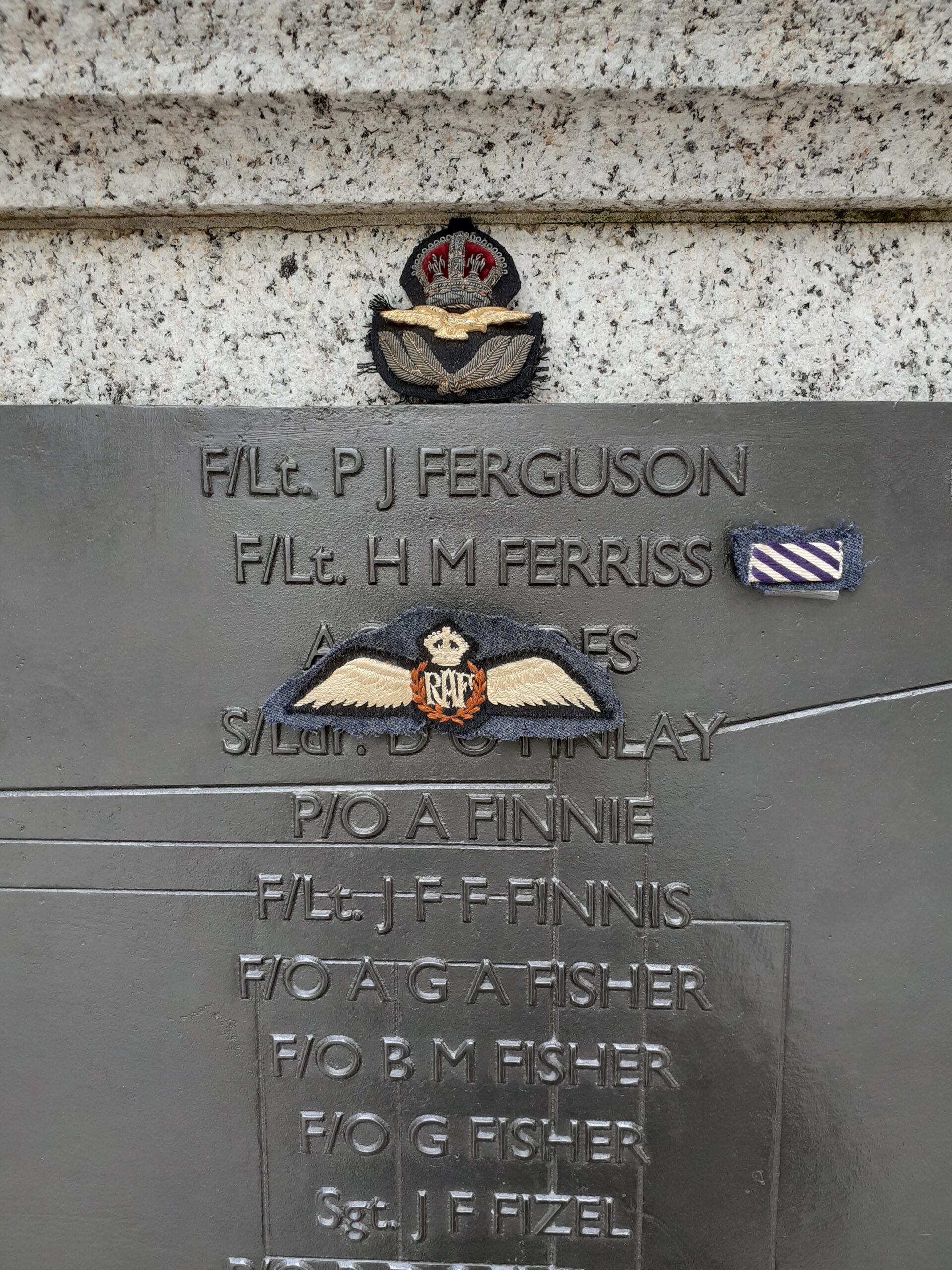
With 10 enemy aircraft officially credited as destroyed, Michael was in the top 1% of RAF Fighter Command pilots in the Battle of France and Britain. Flight Lieutenant Henry Michael Ferriss DFC is buried in the graveyard of Saint Mary’s Roman Catholic Church at Chislehurst in Kent.
48 hours after his death his comrade Flight Lieutenant Connors was also killed in combat. Two weeks later the Squadron was rested from front-line action but by then 11 of her pilots had been killed in the 114 days the Battle of Britain lasted.
Footnote:








No Comments
Add a comment about this page