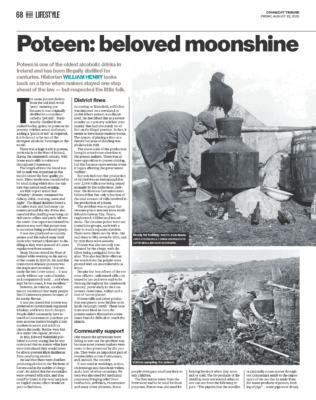

Poteen is one of the oldest alcoholic drinks in Ireland and has been Illegally distilled for centuries.
Historian William Henry looks back on a time when makers stayed one step ahead of the law – but respected the little folk.
The name poteen derives from the old Irish word ‘poto’ meaning pot because it was originally distilled in a container called a ‘pot still. Traditionally distilled from malted barley, grain; or potatoes (in poverty stricken areas) and yeast, adding a ‘pinch of salt as required, it is believed to be one of the strongest alcoholic beverages in the world.
There was a huge trade in poteen, particularly in the West of Ireland. during the nineteenth century, with home-made stills in existence throughout Connemara.
The length of time the blend was left to malt was important as this would ensure the best quality poteen. Three weeks was considered to be ideal during which time the mix ture was turned each evening.
An 1820 report stated that “Whiskey’ (Poteen) remained the Galway drink, morning, noon and night. The illegal distillers found a lucrative trade and had many cu tomers around the city. It was also reported that distilling was being car ried out in cellars and yards ‘all over the town’. One report mentioned the situation was such that poteen was to an extent being produced openly.
It was also produced on country estates and this saulted many land lords who ‘turned a blind eye’ to dis tilling as they were assured of a more regular rent from tenants.
Healy Dutton visited the West of Ireland while working on his survey of the county in 1820-24. He said that Connemara whiskey (poteen) was the staple and recorded, “It is cen tainly the best I ever tasted. It was nearly without any taste of smoke, and comparatively mild… and when
kept for two years, it was excellent.” However, in contrast, another source mentioned that many people liked Connemara poteen because of Its smoky flavour.
It was also stated that poteen was preferred to Government regulated whiskey; and it was much cheaper. People didn’t necessarily have to travel to Connemara to purchase po-teen as some traders brought it into markets in secret and sold it to clients-discreedy. Bottles were hid den under the regular produce.
In 1812, Edward Wakefield pub-lished a survey stating that he was convinced that no matter what laws were introduced they would never be able to prevent illicit distilleries from producing alcohol.
He said that there were distillers producing alcohol in the kitchens of barons and in the stables of clergy men’. He added that the mountains were covered with stills, and they could be found in the very last place an English excise officer would expect to find them.
District fines
According to Wakefield, a £50 fine was imposed on a townland or parish where poteen was discovered. He described this as a severe penalty on a poverty stricken com munity that had absolutely no effect on the illegal practice. In fact, it seems to have made matters worse. The system of placing a fine on a district because of distilling was abolished in 1819.
The share scale of the production brought unwelcome attention to the poteen makers. There was al-ways opposition to poteen making, but this became more serious when it began affecting the government coffers. Solers”
Records indicate that production of alcohol was so widespread that over 2,000 stills were being seized annually by the authorities. How-ever, the Revenue Commissioners. believed that this only a fraction of the total amount of stills involved in the production of poteen.
The problem was so great that revenue police stations were estab ished in Galway City, Tuam, Oughterard, Clifden and Round-stone. The revenue police were sectioned into groups, each with a duty to watch separate districts. There were thirty-two by 1826; this had risen to fifty-seven by 1833; and by 1838 there were seventy.
Poteen was also severely condemned by the clergy, with dis tillers being castigated from the altar. This also had little effect as the words from the pulpits were greeted with an uncomfortable silence.
Despite the best efforts of the rev emse officers, unlicensed stills con tinued in use and were said to be thriving throughout the nineteenth century, particularly in the Connemara mountains, valleys and a host of ‘secret places.
Poteen stills and other production equipment were hidden on is lands on Lough Corrib. These locations were ideal as even the poteen-makers themselves some times found it difficult to reach the islands
Community support
One reason the authorities were failing to sort out the problem was because most poteen-makers were more or less protected by the peo ple. They were an important part of communities across Connemara, and, indeed, the country.
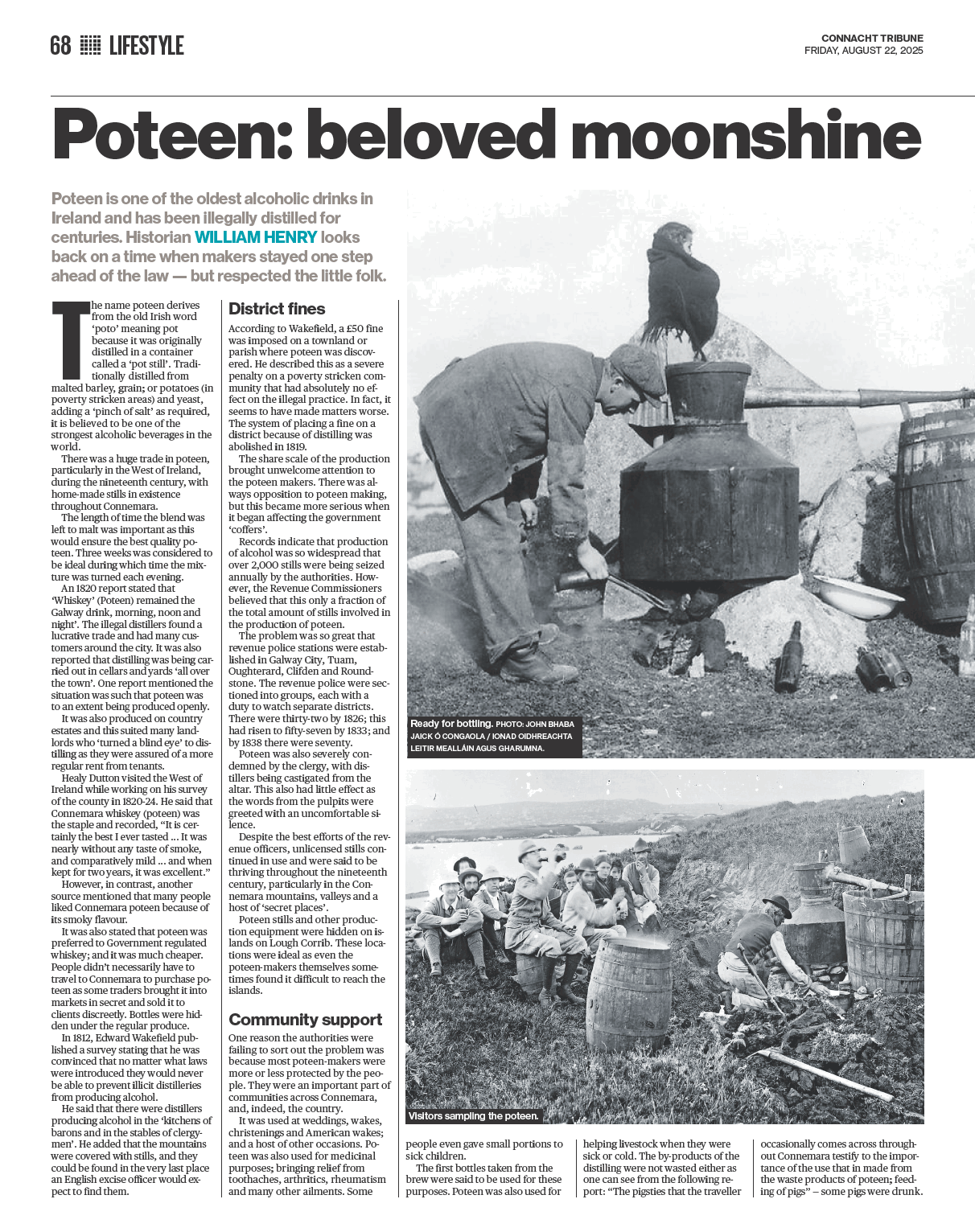
It was used at weddings, wake, christenings and American wakes; and a host of other occasions. Poteen was also used for medicinal purposes; bringing relief from toothaches, arthritics, rheumatism and many other ailments. Some
Visitors samplin people even gave small portions to sick children.
The first bottles taken from the brew were said to be used for these purposes. Poteen was also used for helping livestock when they were sick or cold. The by-products of the distilling were not wasted either as one can see from the following report: “The pigsties that the traveller
Ready for bottling occasionally comes across through out Connemara testify to the importance of the use that in made from the waste products of poteen; feeding of pigs some pigs were drunk.
Quality fears
The fight against poteen wasn’t simply because of the loss of finance. There was also a great fear over the quality of the alcohol being pro duced by some people. The stan dard of the product obviously varied between distillers.
The quality of poteen depended almost entirely on the skill of the distiller. The condition of the equipment was another factor and of course the quality of the ingredients was vital to a good safe product. It was said that if it was poorly produced, poteen could cause death in some cases. This was caused by some poteen-makers producing a less than satisfactory spirit using cheaper ingredients. Many of these distillers were adding quantities of vitriol and soap and then claiming that any offensive taste was because of the malt being dried over a nurf (peat) fire.
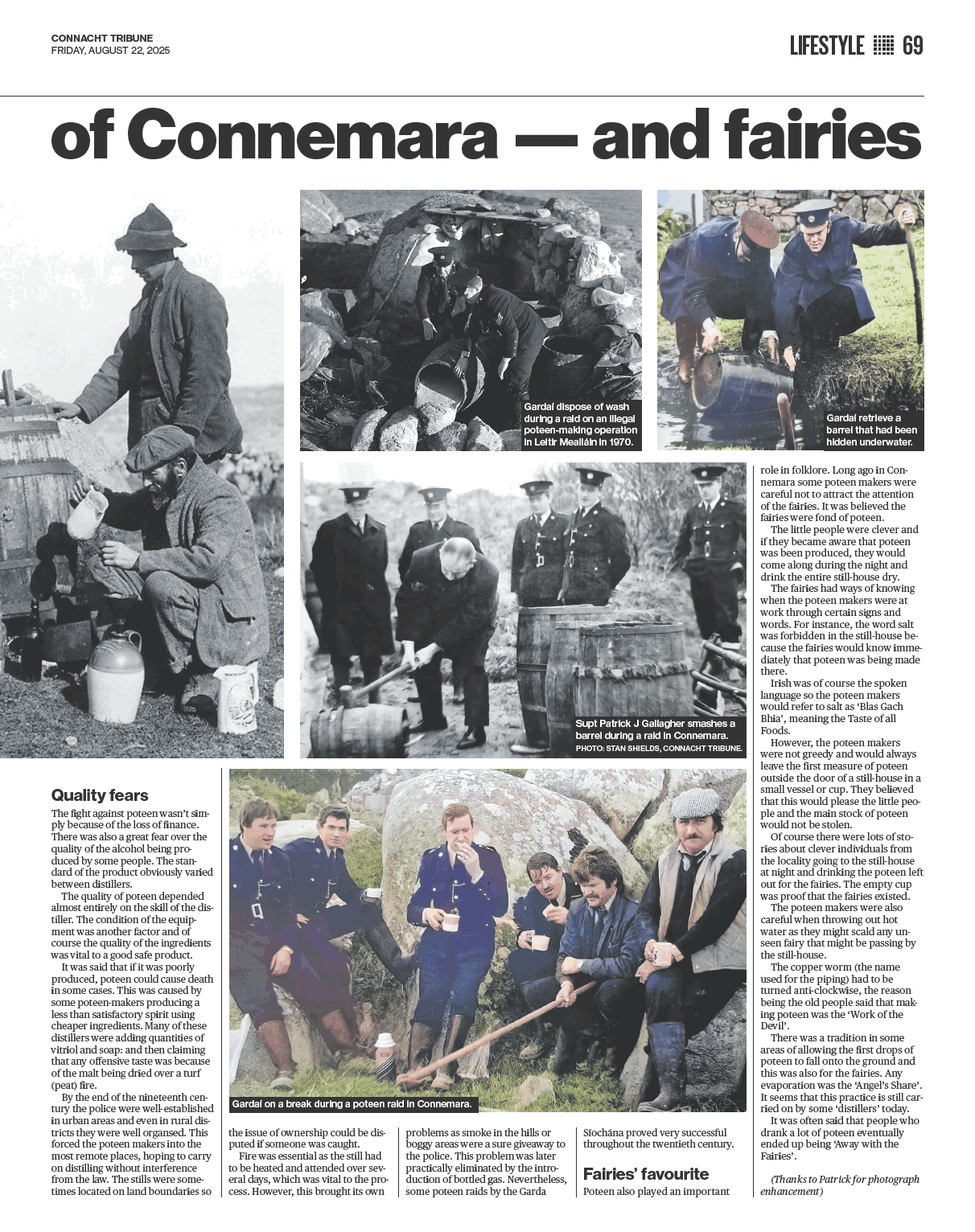
By the end of the nineteenth century the police were well-established in urban areas and even in rural dies tricts they were well organsed. This forced the poteen makers into the most remote places, hoping to carry on distilling without interference from the law. The stills were some times located on land boundaries so Gardal on a break during a poteen raid in Connemara. the issue of ownership could be dis puted if someone was caught. Fire was essential as the still had to be heated and attended over sev eral days, which was vital to the pro cess. However, this brought its own problems as smoke in the hills of boggy areas were a sure giveaway to the police. This problem was later practically eliminated by the intro-duction of bottled gas. Nevertheless, some poteen raids by the Garda Stochána proved very successful throughout the twentieth century.
Fairies’ favourite
Poteen also played an important role in folklore. Long ago in Connemara some poteen makers were careful not to attract the attention of the fairies. It was believed the fairies were fond of poteen.
The little people were clever and if they became aware that poteen was being produced, they would come along during the night and drink the entire still-house dry.
The fairies had ways of know when the poteen makers were at work through certain signs and words. For instance, the word salt. was forbidden in the still house be cause the fairies would know immediately that poteen was being made there.
Irish was of course the spoken language so the poteen makers would refer to salt as ‘Blas Gach Bhia’, meaning the Taste of all Foods
However, the poteen makers were not greedy and would always leave the first measure of poteen outside the door of a still-house in a small vessel or cup. They believed that this would please the little peo ple and the main stock of poteen would not be stolen.
Of course there were lots of stories about clever individuals from fro the locality going to the still-house at night and drinking the poteen left out for the fairies. The empty cup was proof that the fairies existed.
The poteen makers were also careful when throwing out hot water as they might scald any un seen fairy that might be passing by the still-house.
The copper worm (the name used for the piping) had to be turned anti-clockwise, the reason being the old people said that mak ing poteen was the ‘Work of the Devil’.
There was a tradition in some areas of allowing the first drops pis-of of poteen to fall onto the ground and this was also for the fairies. Any evaporation was the ‘Angel’s Share’. It seems that this practice is still car ried on by some distillers’ today.
It was often said that people who drank a lot of poteen eventually ended up being ‘Away with the Fairies”.









No Comments
Add a comment about this page