Traditional & Changing Rites of Funerals in the Oughterard Area
Mary Kyne
Introduction
It set me thinking about rites and the traditions of funerals in Oughterard when I read in the winter edition of “Corrib News 2025” that Therese Kelly of Walshe’s Funeral Directors was awarded her diploma after graduating from the Funeral Directors Course at Glasnevin, Dublin.
Therese Kelly
I started with Dermot Walsh of Walsh’s Funeral Directors, a third-generation family-run business operating over 100 years. I joined during COVID-2021, providing extra support, and care. It was a career I felt comfortable in. I did further training for a deeper understanding. The IAFD Funeral Directing Certificate Award boosted my competence and industry knowledge, covering legal, arranging, and management aspects, focusing on care and empathy.
I’ve seen changes such as more pre-planned arrangements, cremations, and diverse options like civil, humanist, green burials, direct cremation, and home vigils also water cremations. We’re also seeing more funerals with social media, Spotify music, and digital photo albums. I like the digital photos as they give a short story of the life of the deceased.
There’s more focus on supporting families who ask about death certificates, finances, and aftercare. Galway’s recently added support groups like HopeSpace for one example, offering free listening services for bereaved children and young people.
The course has been a fantastic opportunity to network with funeral directors across Ireland. It started small, with just 3 or 4 but now seeing up to 10-15 students showing a real surge of interest in the industry. The course was completed in person in Glasnevin, Dublin, with online resources and exams. (of course, the tour of the cemetery was an added bonus).
Personally, I’ve worked with just as many women as men, reflecting the shift towards a more balanced profession. I’ve noticed changes in funeral customs over the years, especially in rural areas. Younger generations are moving away from traditional expectations, focusing more on personalising funerals to reflect the deceased’s wishes and personality. It’s about making the service more meaningful and authentic.
Funeral gatherings have evolved, and men and women come together, making it a more inclusive and supportive experience for everyone. Times change, and traditions adapt to changing generations. Although personally I love seeing the old traditions I see the changes over the short years that I’m doing funerals, and I have also had to adapt to my job in different situations.
Kevin and Kathy Kyne have been invaluable resources, sharing their knowledge on traditional Irish funerals, and Dermot’s knowledge and explanations have been great. The course has further deepened my understanding, and I’m grateful for the opportunity to learn from them all.
I have also taken a keen interest into mortuary cosmetology which I will hope to advance on later this year. I find family’s expectations of the way the deceased looks after death is now more important. From hair being coloured to nail polish and a certain colour of lipstick.
Clothes are very important and men are moving away from suits, dressing in what was more them such as their jumper, or shirt and pants. I have seen ladies dressed in a Blue Habit only twice. This work is mostly reflected in my job in Galway.
Old Traditions
Wakes
Wakes were a common custom in the 30’s and 40’s. In many cases corpses were kept in their homes over two nights, especially where relatives and friends had to travel from far away to pay their respects to the deceased. Family and friends would keep vigil at the bedside as people would not leave the corpse alone.
Beside the bed, set on the table were three lighted wax candles (blessed in the church on Candlemas Day), a crucifix and a bowl of holy water with a goose feather placed across it so that mourners would sprinkle the corpse and thus gain an indulgence. Mourners today often make the sign of the cross on the forehead of the deceased. Someone took responsibility for changing the candles as they came close to burning out to ensure that no accidents occurred. Now in 2026 this is no longer a hazard as we have battery operated candles.
Cigarettes and cut and teased pipe tobacco were placed on plates and offered to those who wished to smoke. The bereaved family often gave smokers a clay pipe, which they could keep, and gifts of clay pipes were often sent to people who weren’t able to attend the wake. The old women enjoyed their smoke just as well as the men. Snuff was also passed around. I saw older women put a pinch of snuff up their nostrils which caused them to sneeze.
Jars of porter, whiskey, and port was supplied. Poitin was also given, this practice was later frowned upon by the Church as arguments and fights broke out when people were under the influence of this intoxicating liquid. A light meal of jam and bread was offered to mourners, and those who maintained the night vigil would receive a second helping. As the years passed and people became more prosperous sandwiches and often a light meal was provided.
Shrouds and Habits
The corpse was always laid out in bed, wearing a brown or blue habit. The habit was often purchased before the death, and the priest blessed it giving the dead person a special blessing before his/her departure from this life. A habit was a long garment like those worn by monks and nuns – brown for a man with the image of Jesus on the chest, blue for women with the image of the Virgin Mary. Young children were laid out in white. Later men wore their best outfit, a suit and tie and women wore a dressy outfit. Nowadays people were more casual attire.
The bed was covered with a white quilt or bedspread. Fine linen sheets were used. I remember in my own family that the same set of white sheets and pillowcase were laundered after their use and later passed on from family to family. The crucifix, candles and white cloths were stored in a special place. The family was always ready for the final demise of a family member.
Old women didn’t seem to worry unduly about dying. Their biggest concern was how they would look when they were laid out. Having bought the habit before their impending death they were known to try on the habit in front of the mirror to make sure it was the right fit. The men were less vain.
“Cannonball’s Wake”
Who was Cannonball?
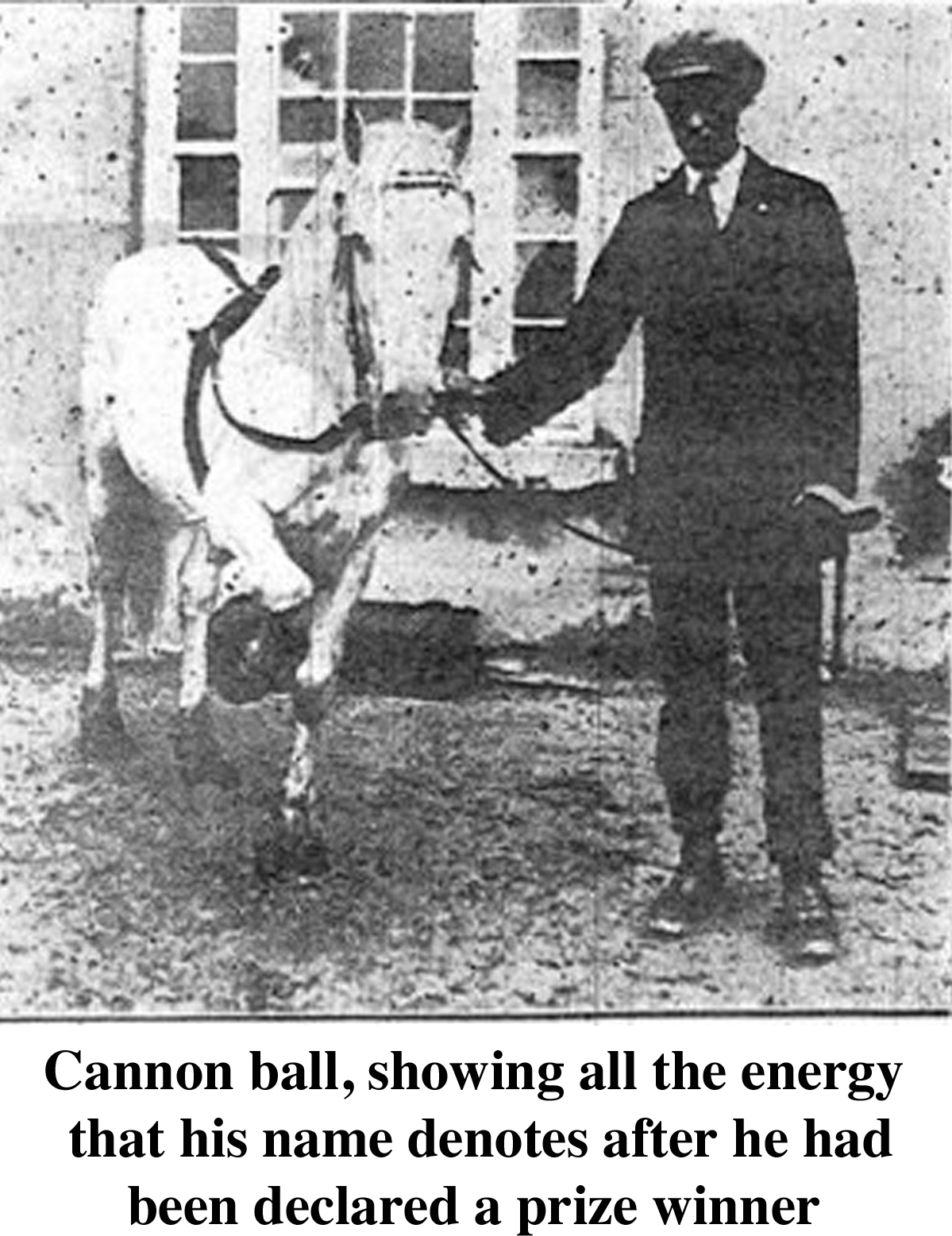
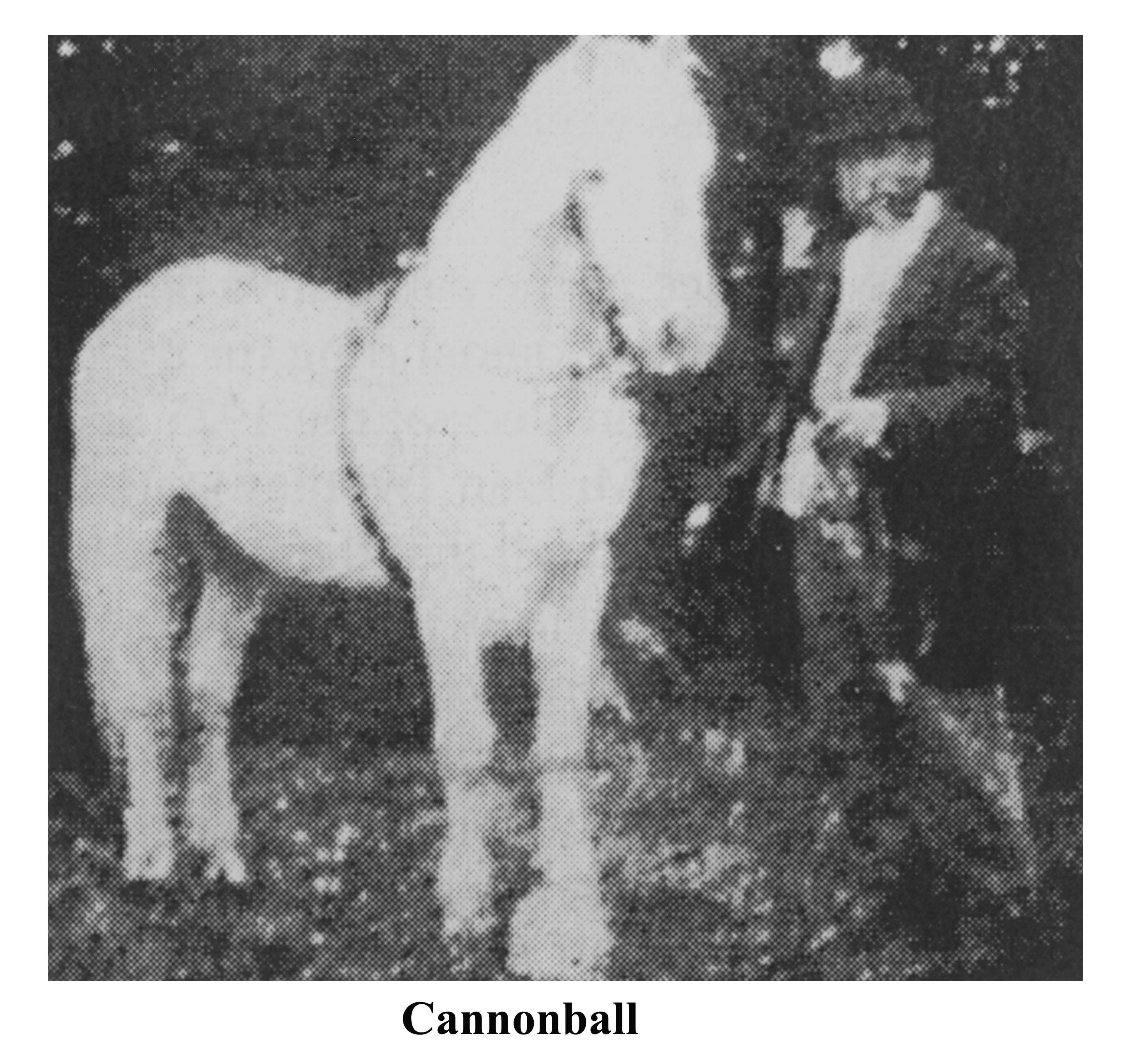
He was a famous local Connemara pony. Born in 1904, he grew to 13 hands and was the first stallion registered by the Connemara Pony Breeders Society in 1926. Harry O Toole, known locally as Honri, his owner, raced him at Oughterard, Clifden, Roundstone and elsewhere. He was never beaten. He even beat the Railway train from Oughterard to Leam and was waiting there when it went past.
Cannonball died on 22nd March 1926, the sad news spread far and wide. His body was laid out in his owner’s kitchen, and a wake was held in the house. A wooden barrel of Guinness was tapped and there was plenty of food and drink for all to enjoy until well after midnight, when, eventually one of those present said, “Let’s take him out of here!” having been carried out on an old door, he was buried with ceremony in a standing position and facing east to Oughterard.
The principal of the local Leam school, Martin O’Dowd was present, having carried other mourners on his motorbike to the wake. He composed a long eulogy in Cannonball’s memory which he recited at his grave.
“Sleep brave old pony, the race is run,
No more with earthly kin you’ll mingle,
Dream of racecourse triumphs you have won,
Of noble steeds and epic deeds
And bookies left without a jingle.”
It was said that the parish priest was not too pleased that a pony had been waked in an inappropriate manner but, when the matter was raised with the owner, his reply was, “I’m sorry only that I didn’t have an “altar” (plate) on him!” by this he meant he would have done very well had he decided to collect the funeral offerings.
A white-thorn tree marked the spot where the legendary stallion was laid to rest.
Washing of the Body
When death eventually came, members of the household had different traditions they followed. The clock was stopped. In my grandfather’s house the huge wooden grandfather’s clock that he religiously wound was stopped. The familiar tick-tock was silent. Mirrors were covered, the cat put out and the milk for churning in the dairy was thrown out. Why? I don’t know.
After an hour or so the body was removed from the bed and laid on sheaves of straw on the floor before being washed.
In this area nurses Maud Geraghty, Nancy Mc Aleer, Margaret Molloy, Maire Seoighe from Baurisheen, Nora McDonagh and her sister Una Darcy originally from Magheramore and older women in the villages around performed this ritual with great respect and dignity for the deceased. There was often a man present to help lift the body on to the sheet draped table for laying out.
Sheets were hung on the whitewashed walls against which the table stood holding the crucifix. The body was placed on the bed and covered with the white quilt leaving the hands visible holding the rosary beads.
To complete the ‘laying out’ a holy picture was hung on the sheeted wall. No tears were shed until ‘the laying out’ was completed, then the old women recited the rosary prayers or sang a dirge, a caoimeadh – ochón! Ochon, why did you leave us or words to that effect.
In hospitals the nurses often attended the person in the ward before the body was taken to the mortuary. The hospital porter generally helped by lifting the dead person into the coffin.
Women Keeners
There were recognised keeners in every area, some were paid for their services. They usually wore black coats, hats and shawls. A widow wore black clothing as a sign of mourning after her husband’s death. Men mourning a close relative wore black ties and a black diamond shaped cloth on the sleeve of their jacket. A twelve-month period of mourning was observed, and no family member was allowed to attend any form of entertainment.
Wearing black attire reminded everyone in the community to be mindful of the grief that person was going through. Support was given freely within the community and allowances were made. People were discouraged from making important decisions during that period of mourning. Today it is not obligatory for funeral directors to wear black clothing, but many do choose to wear a black suit, tie for men and a suitable black outfit for women.
Embalming
The ritual of washing the body ceased when loved ones were sent for embalming. It was not always part of the Irish funeral. Pre electricity houses were dimly lit. Any decomposition of the body being waked was not as visible, but it was there as one would experience an odour.
Fires were lit and a lot of people congregated for the wake making the house very warm. Once electricity arrived society sought other means for better presentation of the remains. With embalming there is no urgency with funeral arrangements and there is no odour. The body is sanitised. Embalmers ensure that the deceased person appears true to their living self as they lie among their loved ones for their final hours. The last time, you see them is most likely to be one of your strongest memories of them in the years ahead. Good embalming is futile if it isn’t coupled with equally good presentation.
Types of Coffins
The undertaker made the coffins years ago. It was considered bad luck to make a coffin in advance of death, but often the side and other parts were made, stacked and then assembled and packed with wood shavings or hay for padding. The coffin handles had to be screwed on as well as the breast plate. The person’s name, age etc. was inscribed on the plate.
Usually, all the coffins used in an area are of similar size, though have different designs. However, caskets from America, those of emigrants being repatriated for burial, brought challenges for grave diggers as they are usually much larger than the coffins we were used too.
Funeral directors often get requests to place items in the coffin, from newspapers, reading glasses to letters and cards from grandchildren, watches, photos, bottle of holy water, fist of clay from the land to continue that connection with their home place as the deceased move into the spiritual world. Death is a very personal thing, while putting items into the coffin might seem ridiculous to some, it is the meaning that they hold for the deceased or bereaved, that is important. It is often small thing that brings comfort and help to people through their darkest days. People now often throw a single rose or flower into the grave of a loved one before it is filled in.
Green Coffins
Green coffins are now made by crafts people. They use 7ft lengths of willow, which is pliable, that’s one year growth. They start with a solid timber base for rigidity and, you stake it up, just as you would a log basket, and then you weave out the sides. The lid is the hardest part as the work is completely free hand as it needs to fit the base neatly.
Every coffin is different. It is hard work especially on the craftsman’s hands. The coffins are very popular now among families and undertakers. At first people thought they were a cheap option, and as a coffin is the last item you purchase for a loved one families didn’t want people to think that you were buying something cheap. They are not cheap as it takes 2-3 days steady going to make one. Coffin makers treat their trade with great respect, mindful that someone’s loved one will rest in it.
Workhouse Burials
The Oughterard Workhouse was opened in 1852. There was a fever hospital attached to it and nearby stood the Dead House. People who died from starvation and cholera fever were buried in the ground known locally as “Teampaillín” on the Canrawer Road. Their bodies were brought from the Dead House in a small handcart. Many were buried without coffins but on other occasions a simple plain coffin was used.
In some instances a mobile coffin with a sliding bottom was used and the bodies were dropped into the grave. The mobile coffin was mounted on wheels as it was also used to collect the bodies of the poor who had not gained admission to the workhouse and who had died of starvation or fever on the roadside.
Sometimes people who died like that were buried where they died on the side of the road. This happened on the way from Maam Cross to Oughterard.
Stephen Lydon and Tom Walsh were in charge of the burials.
The burial ground “Teampaillin” was not blessed and therefore it was not called a cemetery. In 1996 Canon Tully, the local parish priest blessed the ground and the graves. The family of Frank Mc Donagh, Bealadaingean, who died on the 16th August 1916 erected a headstone over his grave. It is the only headstone in the graveyard on the far side of the field. The ancient graves are simply marked with a large stone. A circle of smaller stones marks a child’s grave. Some years ago Galway County Council secured the ground by building a stone wall along the roadside.
There are several Famine graves just inside the gate of the local cemetery marked by large stones. Most unknown.
Children’s burials
Still born or un-baptised babies were also buried in a small wooden box. Such burials took place early in the morning or late at night, often in remote places. How those families suffered burying their loved ones in total isolation.
Funeral of Seamus O Máille, 1923
Deaths in this area were marked by private and public rituals, notably the death of Séamus O Máille.
On the 11 th April, 1923 six republicans were executed by the forces of the Free State army in the Tuam workhouse. The six bodies including that of Séamus O Máille were interned in individual coffins in
consecrated ground in the Tuam Workhouse. The news of his death came as a shock to the people of Oughterard. Later in 1923 the Free State Army vacated the Workhouse and the remains of the six men
were exhumed and quietly transferred to Athlone for reburial in 1924 without the consent of the families.
This lack of sympathy by the government met with considerable criticism from the general public.
Eventually it was decided that all the bodies would be released in a single day to the families.
On the 28th October 1924 a ceremony was held in Athlone at which the bodies of 18 executed republicans were returned to their families. A chaplain officiated along with Major General Seán Mc Keown of the
Western Command of Oglaigh na hÉireann (the official Irish Army). Each coffin had a disc attached identifying the occupant at the time of the original burial. As each coffin left the barracks, at ten-minute
intervals, full military honours were accorded them as they passed by.
The Connacht Tribune reported:
“Not withstanding the inclemency of the weather, a drenching downpour continuing from early morning, a large crowd had collected in the square, or market place, opposite the west gate of Costume Barracks.
Many of the spectators were women and girls. Shortly after 11o’clock about 20 motor vehicles arrived and were lined up from the Market Square to Costume Place. A few minutes before 12o’clock a guard of
honour of the IRA arrived and was formed up in double line facing the entrance to the barracks. The bodies in addition to the coffins they were originally buried in were encased in large oversized oak
coffins, stained yellow. Friends travelled from north and south the previous day and stayed overnight in Athlone. James O Malley, Oughterard was the first of the executed six in Tuam on the 11th April 1923 to be handed over, followed by John Newell, Headford, Martin Moylan, Annaghdown, John Maguire, Cross, Co. Mayo, Francis Cunnane, Kilcoona, Headford and Michael Monaghan, Headford.
The coffins were draped in the republican tri-colour, and bore a breast-plate provided by the relatives on which was inscribed in Irish, the name, date of death and age of the deceased. The spectacle presented after the coffins had been removed from the Barracks, was to be a never-to-be forgotten one, a grim reminder of the unfortunate division between comrade Irishmen which was the result of Mr De Valera’s
refusal to accept the Treaty. Others would maintain that it was the Acceptance of the Treaty of Surrender and the armed over-throw of the All-Ireland Republic caused the unfortunate division between comrade
Irishmen.
The Funeral Cortege made its way from Athlone to Tuam and from there to Headford. In Tuam a large crowd remained on the streets in torrential rain awaiting the arrival of the funeral which was running late.
As the funeral cars drove slowly through the town, heads were uncovered, and the soldiers and the Civic guards saluted. Spanning some of the principle streets were streamers with mourning crosses in
Republican colours. There was no delay in Tuam and all the cars proceeded to Headford where they arrived at 1.30a.m. On passing Beclare the church bell tolled lending a solemn sadness to the country side
at that late hour of the night. The tri-colour-draped coffins lay in state overnight in the church.
Comrades of the North Galway brigade, IRA, stood guard all night. The following day, October 30th 1924
High Mass was offered in Headford for the repose of their souls.
Séamus o Máille was brought to Oughterard where he remained overnight and was laid to rest in the Republican Plot Kilcummin Cemetery. A general day of mourning was held in Tuam and the surrounding
towns by having businesses suspended during the day.
The Government had forbidden the firing of guns in salute, but were carried out when the army had left the vicinity of the graveyards.
Ar dheis Dé go rabh a anamacha dílis.
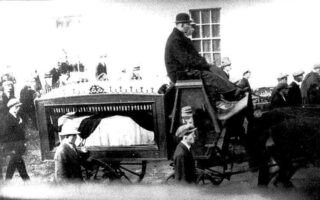
Funeral of Séamus O’Maille 1923
Funeral Cortege
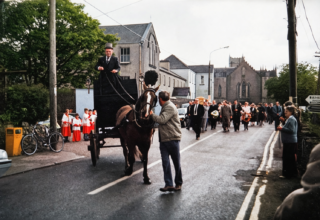
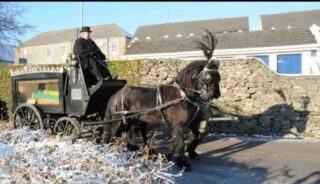
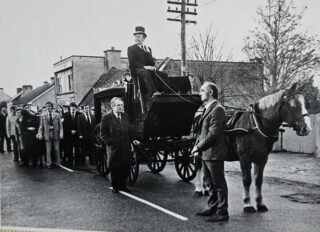
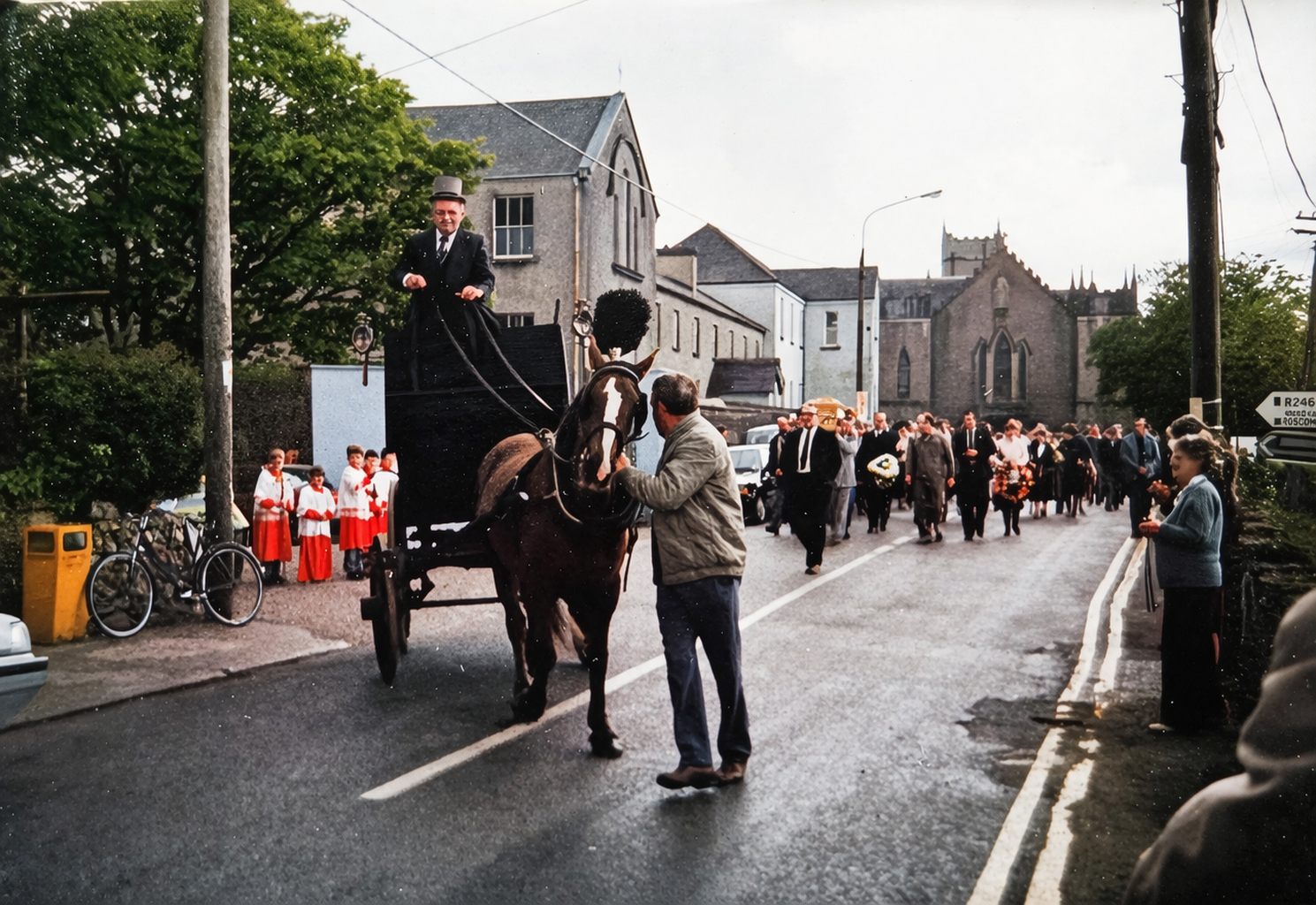
In the olden days a funeral cortege had a pair of black horses that drew a carriage just like Paddy Geoghegan, Canrawer owned. If the house was not far from the church the coffin was shouldered by family members and neighbours. They would also dig the grave, a tradition which is still carried out as far as possible to this day. The old traditional funeral – no gifts, no music, no eulogy at the funeral Mass, the burial took place after mass and people went straight home – that would be a rare occurrence now.
Families want music, bringing up items associated with the person’s life, telling the deceased life stories which bring laughter and tears to the grieving relatives. You were said to have a great “send-off” or a mediocre one depending on the size of the crowd or the hospitality “dished out”!!
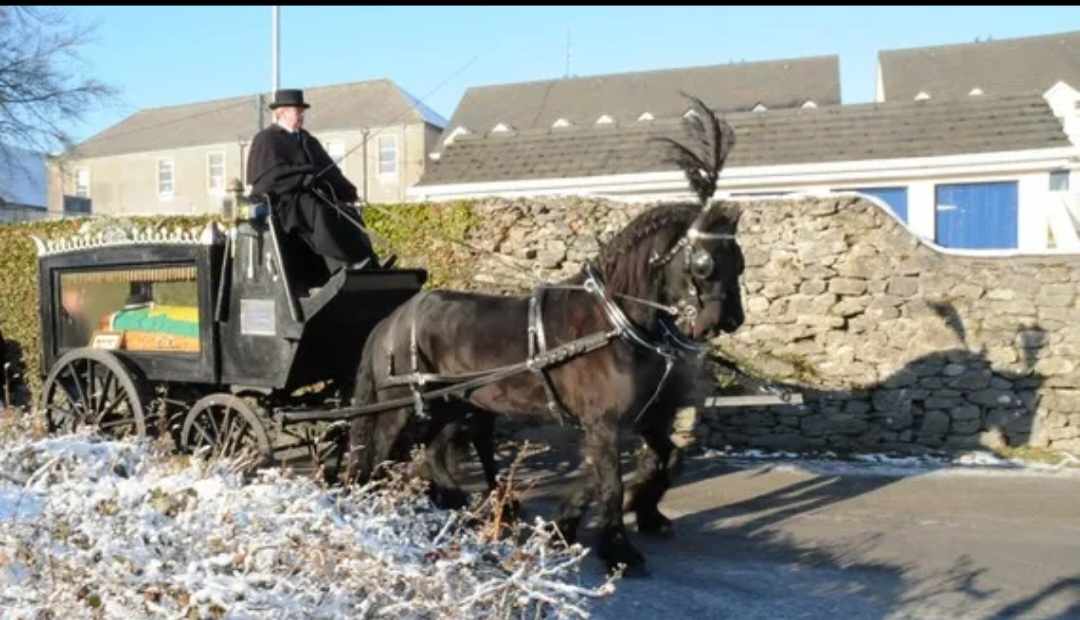
Geoghegan’s Horse drawn Hearse and Carriage
Carriages represent a time gone by, a slower, statelier era when horses were central to everything people did and everywhere they went. The term “hearse”, originated from the Medieval French word “herse”, meaning a harrow or large spiked rake. Initially it referred to a triangular, candle lit framework placed over a coffin. They were originally hand drawn, then horse drawn, then horse drawn open wagons with a platform to move a coffin and were pulled by horses. Later they evolved into covered wagons pulled by horses.
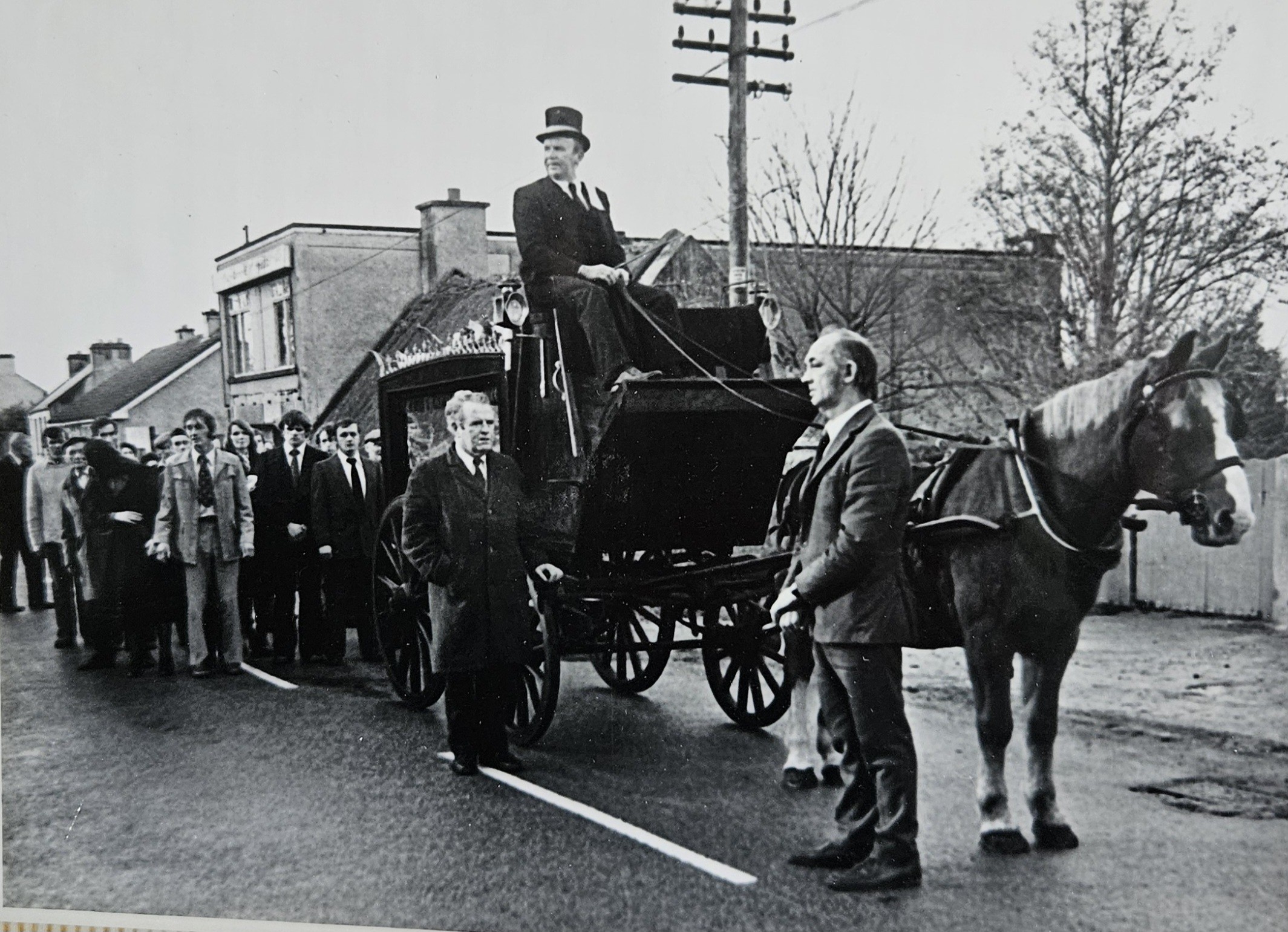
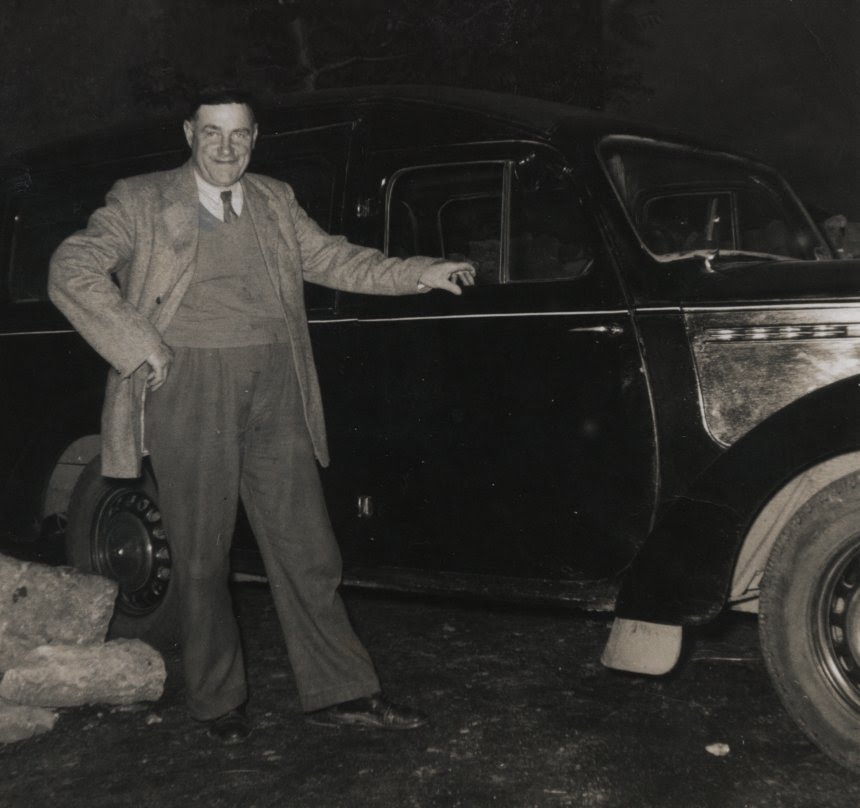
It was one of those hearses that Paddy Geoghegan purchased from Seán Conneelly, Main St. in the early 70’s. The “mourning carriage”, as it was known came from Nan Burke’s yard where it was stored. The hearse is still in Geoghegan’s shed in Canrawer. Mr. Darcy from Maghera drove the hearse.
1750; The makers name, “Thrupp and Naperly” built hearses in West East London. They were coach makers for Queen Victoria. The company operated for over two centuries, later developing bodies for Rolls Royce, Daimler and Bentley. The Company’s name is stamped on the four iron wheels. The carriage had glass windows, highly ornate decoration on the sides and on top. While the Geoghegan family were renowned Connemara Pony Breeders, they did not use the light Connemara pony for such an onerous task as a funeral, instead the heavier Irish draught horse, the Friesian breed was used. After Paddy Geoghegan died the horses came from J. O’Grady.
The horses drawing the carriage wore large plumes of ostrich feathers on their heads, large brass lamps hung on each side.
It was not a business for the Geoghegan family, close friends and family used the hearse for private funerals. Paddy Geoghegan and his wife Angela, Roland and Tommie Mc Donagh, Jack Boulger, Val Moran, Westport, to name a few.
When the motor hearses arrived the carriage languished in barns as did Geoghegan’s hearse, but Paddy Geoghegan saw a value in purchasing his one in 1970. He had the intention of preserving it for future generations but unfortunately it never materialised except that he got a few years use out of it.
Funeral Homes
In the last twenty or thirty years funeral homes have become more popular, and the hearse is the modern mode of transport. The funeral homes are warm and comfortable with modern facilities to cater for mourners who come to pay their respect.
The aim of the funeral homes is to look after the deceased without losing the traditions of the Irish funeral as far as it is possible. It does not have the feeling of a mortuary or a church but rather something more domestic, as a funeral home can have a meeting room, toilet facilities and often a small kitchen for refreshments for grieving families. It can enable families have the intimacy of their own home for relations and close friends, while at the same time cater for larger crowds coming to pay their respect.
The priest blesses and recites prayers before the corpse is brought to the church. When the funeral arrives at the church the coffin is carried shoulder high into the church where prayers are said and scripture readings are shared. A layman’s coffin is always facing the altar: the feet towards the altar but the clergy face the congregation.
Shortage of Priests
For centuries all over Ireland, the clergy were closely involved with death. The frequency of death at different times in our history, the great Famine 1845, Flu epidemic 1918 and the spread of TB in the 50’s, had a great impact on communities and the morale of families was a daily challenge to faith and endurance. Now in 2026 we are faced with a different challenge, the shortage of priests.
In several instances some parishes in a region are now collectively served by one priest. The present bishop of Galway, Michael Duignan is introducing funeral guidelines. He hopes to have a funeral support group in every parish who will have the pastoral means of serving grieving families. It will take getting used to having lay people serve at wakes and funeral removals and burials.
In our parish Denis Geoghegan takes on the removal of the deceased when our parish priest is unavailable.
Porridgetown Traditions
A person from Porridgetown remembers that the coffin was placed on two chairs or a stool outside the family home as the custom was that it would not touch the ground until it reached the cemetery. Mourners cried loud and hard at the final parting. They had to be careful not to drop tears on the corpse once it was in the coffin, possibly in case it might disturb the peace of the deceased.
The family stood with “The Plate” and people dropped in their contribution as they filed past paying their respects before the removal of the corpse to the church by horse and cart in the earlier days, before they had the use of a hearse. The chairs and stools were turned over. What that symbolised, I don’t know.
The Plate
When I came to Oughterard in 1967, I was pleasantly surprised to see the family of the deceased person stand at a table outside the church door. The mourners dropped money into the plate.
Foolishly, I thought it was a great idea as the money would help to defray the funeral expenses, not so! It was a contribution towards the church funds. The practice was known as “The Plate”, a shilling for the Plate! More copper coins than shillings were dropped in at the time. Charitable contributions are now dropped into a box at many funerals for various groups like the Hospice, Croí or First Responders etc.
Cremation
Cremation is on the rise in 2026. Nowadays, approximately 30% of deceased persons are cremated. When a person dies overseas, it is now usual for the body to be cremated. The ashes can be brought back in hand luggage, but it must be accompanied. Coffins come in as cargo and freight. It must be screened and checked, including by sniffer dogs, before being released. The undertaker is the one who receives the coffin at the transport hub. Coffins for cremation are often made of wood or wicker willow; all different price ranges. The coffin enters the chamber with the body and afterwards the ashes are placed in an urn and returned to the family.
Covid -19
Covid brought many changes. Everyone had a personal story of what life was like in isolation. Friends recovered from the virus which gave us hope but sadly too we lost loved ones which caused us great pain, people suffered alone not being able to bury their dead surrounded by the support of community, family and friends. No more than 10 people could attend funerals as we were asked to avoid close spaces, crowded places and close contact settings.
Bhíomar ciallmhar i gconaí maidir leis an mbealach ab fhearr linn féin a choinneáil sábháillte is cuma cá raibhaimid, céard a bhí ar siúl againn nó cé a bhí inéineacht linn.
There were different requirements for burials and funerals for those who died from Covid.
● Carrying the coffin, a traditional practice was not allowed.
● The funeral director took care of the preparation of the body, removal from the care setting and preparing them for the funeral or cremation.
● In order to manage the spread of any infection, the coffin was closed and, only in very rare circumstances, was it opened for viewing. This was to protect the family and others.
● The funeral was planned as private for close family and up to 10 people could attend.
● Families could notify people of the death and could place a death notice but often no times or venues of the funeral were published on line, by radio or in print.
● If the funeral was streamed, broadcast from the church/crematorium or other setting the link could be provided to people at home or abroad.
● Relatives had to remind family and friends that people with respiratory illnesses including those who had known or suspected Covid-19 were being asked to self-isolate and to avoid public gatherings including funeral services.
● On the day of the funeral people were urged to follow the advice on social distancing when travelling to and from the funeral gathering, should avoid any hand shaking or hugging. They should also continue to practice good hygiene and sneezing etiquette.
● People were not able to gather in a restaurant or someone’s house after the funeral. It was suggested at the time that they could come together for a virtual gathering over Zoom or a similar platform – all very alien to Irish traditional values.
How did people cope?
It is now difficult to understand how people coped during those uncertain fearful times.
So much was out of control of the immediate family, but they still choose reading’s, poems etc. to remember their loved ones, even if the service was much smaller. People received letters recording the memories of the person who had departed this life. People tried to keep in contact and tried to be open to others contacting them. In that way they still felt connected even when they were not together. They also used social media.
Families were advised to involve children and young people, to keep talking to them about the person who had died. It was advised not to use the actual Book of Condolences. The use of RIP.ie method of expression sympathy was used as it is today.
Tradition Revived
The Irish people found new ways to show their respect to the dead during the strange times presented by Covid restrictions. Neighbours stood at their gates as the hearse passed by as they were asked not to line the roads. They left food and meals for family members, always adhering to social distancing. They wrote letters of support and condolences. They kept in touch by phoning and texting the bereaved, not just at the time of death but in the weeks and months following the death.
The older people also remembered the hardships endured by families in the 40’s and 50’s when young and old were afflicted with TB (Tuberculosis) epidemic, not unlike Covid as several members of the one family died of the decease as it was contagious.
Coffin Resting Stones and Cairns
When families didn’t have a pony and trap to carry the coffin to the church, family, friends and neighbours would shoulder the coffin to its final destination. They would rest the coffin on a stone along the way.
Some would place a stone on cairns and people going about their daily tasks would pray for their ancestors as they passed by.
Seán Osborne in his book, “Bits and Bobs” cites them in his region.
“There are 2 leachtanna in this region. One is situated within 100 meters south of Gortbeg road.
On the top of this hill on the southeast side there are a number of little rock mounds. When the funeral was passing on its way to the graveyard some stones were added to the heap which were locally called caisleáns – in other words “cloch le carn”. The other is located in the townland of Cornelistrum on the Kylemore rock road, on the west side. There are a number of caisleáns still in existence there. The practice of adding stones died out around 1950. Some of the caisleáns in Kylemore are nearly two meters tall.”
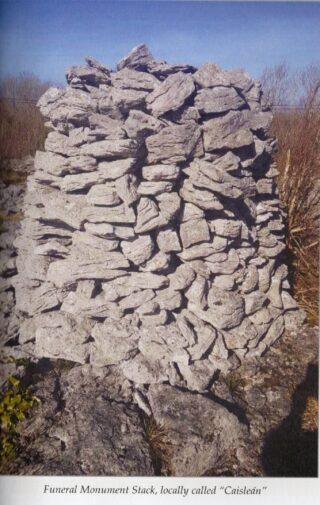
“Caísleán” Photo Credit: Sean Osborne
Leachts are in Magheramore, Tullaghcoth & Bunnigappaun.
Grave diggers
There were no machines for digging graves in times past, in Oughterard, the grave diggers dig carefully using spades, shovels and a pick if necessary. Neighbours and family members still assist them. It is a special time for the diggers as they reminisce about the dead person and others around them in the graveyard. I have seen families line the bottom and sides of the grave with moss which gives a gentler look to the harsh clay and stone surface.
Church Services TV
Church Services TV in its present form was established in 2005 helping parishes and other religious organisations expand their reach. It connects communities and family members at home and abroad when they are unable to attend and pay their respect in person to the grieving family. The wide circle of friends of the deceased can leave messages of sympathy which are a great consolation to families.
Skills of the Funeral Director
Special skills are required when people are grieving the loss of someone they love and care about, they are very sensitive and full of a myriad of emotions. They need time to work things out and the funeral director has to be patient and tactful and may have to intercede from time to time to keep things moving and help them at the same time to navigate through this difficult time.
The funeral director is an independent person outside the core group involved in the funeral, he/she can empathise, but still manage matters in a rational and compassionate manner.
His/her skill transcends all faiths and belief systems.
Tell me about Walsh’s Funeral Directors – How did it start?
I put the above question to Dermot Walsh.
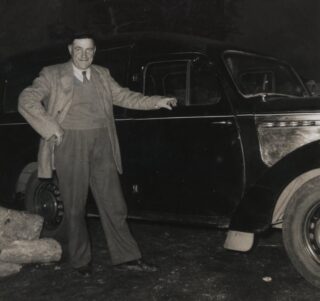
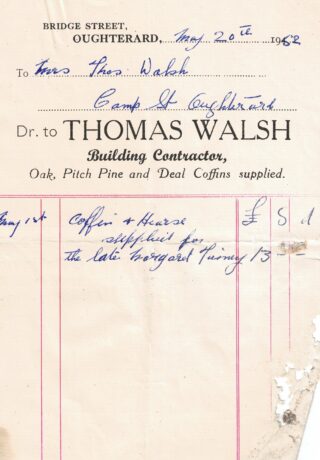
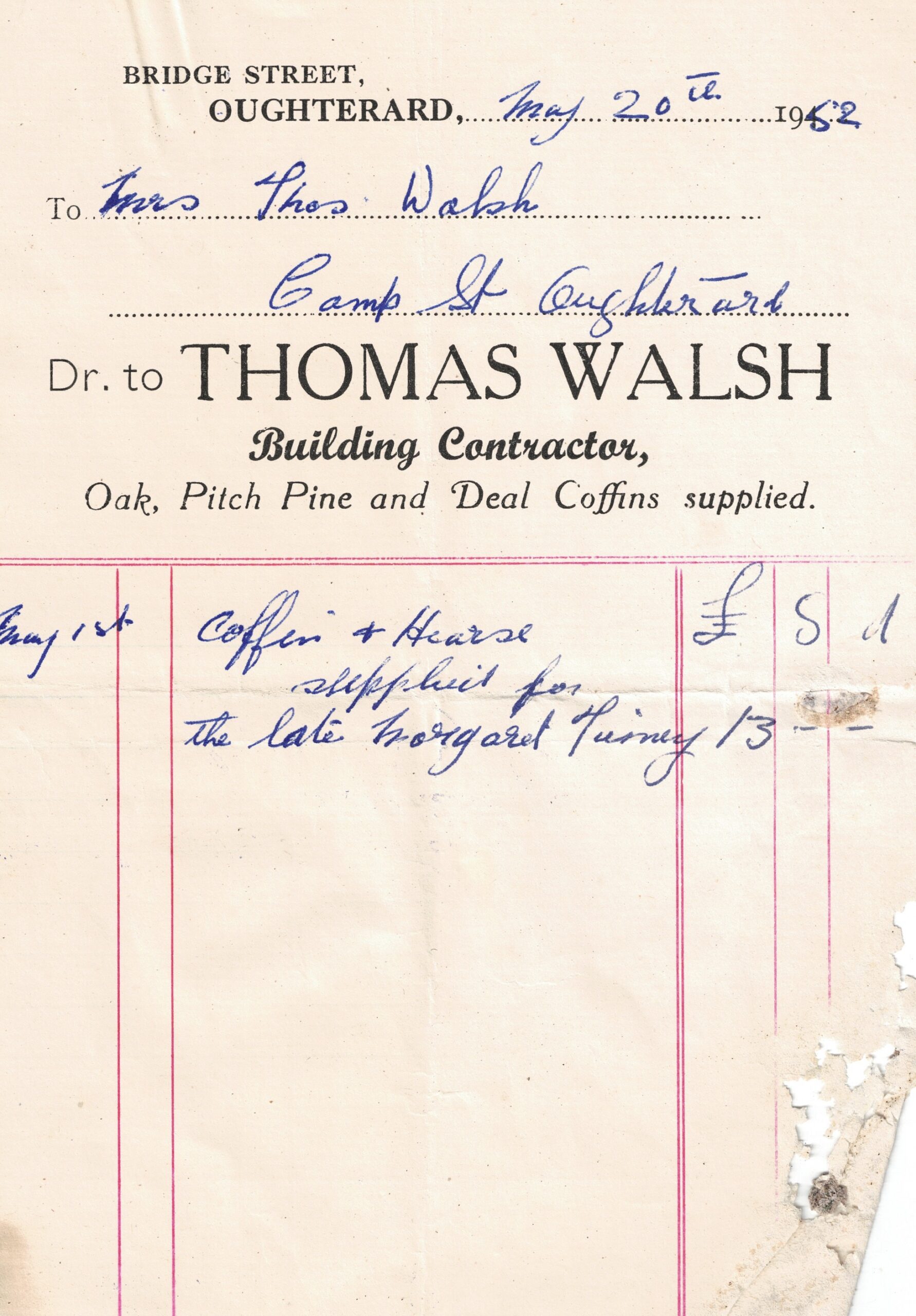
Around the 1880’s in Oughterard, two brothers Johnny and Michael Walsh of Bridge St had a business hand making coffins for bereaved families all across Oughterard and the surrounding area using traditional methods. They were the ancestors of Dermot Walsh, our undertaker today.
In 1916, Dermot’s father Tom Walsh, then just 15 years of age, was sent from his home in Magherabeg to work with Johnny and Micheal to learn his trade as joiner and coffin maker. Tom was later joined by his brother Willie. Together, they would measure and cut the timber to size and fit the planks together before coating the inside with boiled pitch from an open fire. This would ensure that the coffins were watertight. They used hay to pad out the coffins before adding the silk like material for lining. The brothers stored the coffins in a tall stone workshop in the yard behind their house at Bridge St.
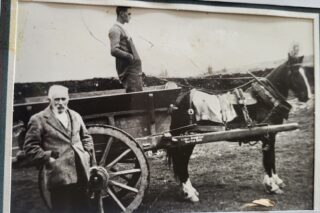
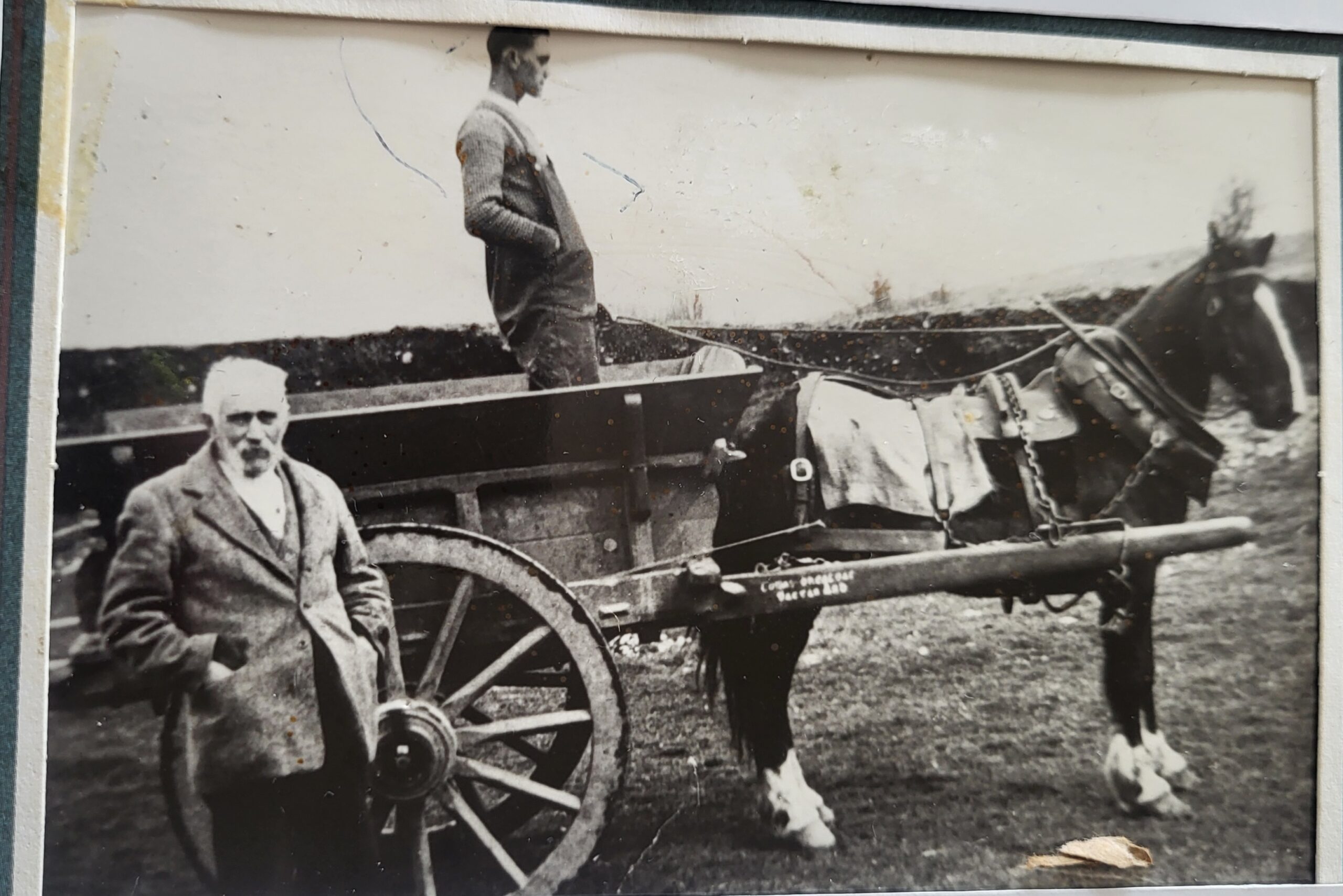
When a bereaved family got in touch with the Walsh’s for a coffin, Tom would deliver it to their home. On some occasions, the family would be able to afford to hire a horse hearse but often, when families could not spare that expense Tom or Willie would bring the coffin to the church with a horse and cart or with the horse and trap.
Tom married Catherine McDonough from Pittsburgh and settled down to have a family at Bridge St. As their family grew, so too did the funeral business. Dermot was the youngest child and grew up in a family where everyone was involved in tending to the deceased and helping the distraught and heartbroken people, they leave behind.
How did the business expand over the years?
A few years after the Second World War in 1948, Tom purchased a motorised Bedford van which was the first motorised hearse in the area. However, the van was not solely used as a hearse. Dermot tells me that Tom, his dad, once brought 12 people to Tuam stadium on the 30th of August 1953 to see Oughterard play Dunmore in the County senior football final. Sadly, Oughterard were defeated that day and the trip back was a sad one but that wasn’t the van’s fault.
There were no phones in the early days, people just knocked on the door of Walsh’s at Bridge St to place an order for a coffin or for a habit. A habit was a shroud like garment which a lot of people were laid out in, generally brown in colour for a man or light blue for a lady. If Tom was out his wife Catherine would console the bereaved and take the funeral details. Like lots of family businesses everyone was involved in some role.
When Tom passed away in 1967, Dermot’s uncles and older brothers took up his father’s mantle, their own grief making them even more empathetic to the mourners they supported and guided. The Funeral home on Main St was opened 1989 and renovated by Dermot just a few years ago to ensure the space is as warm and inviting as possible for mourners.
It was never an automatic decision for Dermot to take over the business, but it was a natural fit for him. His first experience was at the age of just 17 when he had to bring a body to Galway hospital for a postmortem. That was the start of Dermot caring for the deceased and bereaved of the area and he is still doing it nearly 50 years later. He trained in Hotel Management, spent time in America before returning home and going back to the family business.
What does an undertaker do?
The role of the undertaker has evolved over the years as Dermot said, “I’m more an event organiser” helping families at a time when they need to focus on consoling each other. Some of Dermot’s role includes putting death notices on local radio, in papers, Rip.ie, which has gained in popularity since Covid-19, all to let keep friends and people in the community know of any recent deaths, which allows them to pass on their condolences either in person or by signing a condolence book or by posting a message on RIP.ie.
He also helps ensure the wishes of the family are carried out, whether that be regarding the presentation of the body (make-up, hair, nails), coffin selection, flowers, or music. The fee’s incurred for these services are covered by Dermot to allow the families peace of mind at a difficult time for many financially. The practicalities of arranging the funeral are also covered by Dermot such as grave diggers and removal of the deceased from place of death to their final destination.
Gone is the day when mourners went to the back of the Church and stood with the “Plate” and shook hands with the bereaved family. People found it humiliating when the total received was announced in Mass the following week. Now people discreetly place a donation for a charitable cause in a box at the door of the Funeral Home door.
The Walsh family have worked with several grave diggers over the years: Pat Conneely, Mike Connor, Paddy Clancy, Seamus Geoghegan, Paddy Roche, Tom McGauley, Johnny Folan, Mike Bartley Molloy, Jim Healy, and with the County Council Graveyard caretakers: Tom Harris, Mike Darcy, Patch Donnellan, Tom Conneely and now his son Kieran Conneely in 2026.
The undertaker’s business was male dominated because there was such a physical side to it. Nowadays, there is technology to help with that problem, such as the introduction of a coffin hoist. Coffin making and embalming are also outsourced and now more women like Therese Kelly are becoming involved.
How did Covid-19 affect funerals?
Covid-19 brought many changes for undertakers as they were obliged to follow strict rules set down by the Government. During that period of tight restrictions between 2020-2022 Dermot had many funerals of people which were extremely difficult on all involved from clergy to grave diggers, but nothing compares to what the family of the bereaved went through not being able to grieve their loved one and be consoled by extended family, neighbours and friends.
It is now noticeable that a new trend is emerging with funerals, there is less Church involvement. As Ireland becomes increasingly secular, there are new options available for families. 15% are what is termed “Lay Funerals” or “Humanist Funerals” that have no religious involvement. A family may also have a celebration of the person’s life at home. Dermot has seen this change directly and is able to offer guidance on new options available for families with different religious beliefs.
What are the qualities needed for Undertakers?
Dermot would list empathy as one of the most important factors when working with grieving families, allowing you to recognise what the family are enduring parting from loved ones. An understanding that the family needs support and gentle guidance is essential as well as a sense of discretion given that you are being invited in to see the inner workings of a family during a very difficult time.
Anyone who has attended an Irish funeral will know that one thing people love most to do is reminisce on fond memories and old yarns of the deceased. To have a good sense of humour is a great quality in all walks of life, including as an undertaker.
As with many jobs good communication skills, respect, dignity, punctuality and sensitivity are all essential.
People in this locality have trusted and are indebted to the Walsh family as undertakers for their professionalism in looking after members of our community in their hour of need.
In conclusion Dermot would like to dedicate this interview to the memory of the deceased members of his family but also to the memory of the countless bereaved families of Oughterard and the surrounding parishes that have lost loved ones and entrusted Walsh’s to take care of their funeral , Walsh’s have been in business for more than 120 years making them the longest established business in Oughterard and we wish them many more years of success.
Conclusion
In Oughterard great respect is shown towards the deceased by the community, shops close their doors and workers stand outside their premises as the funeral cortege passes by. Pedestrians bless themselves by making a sign of the cross. Many clubs form a guard of honour, a common occurrence in the town.
The Irish do funerals well, as it through the rituals of death that resolution and healing can take place, that pain and loss and anger can become dissipated and order, stability and peace can be restored.
Suaimhneas síoraí do na daoine go léir atá imithe ar shlí na fírinne.
Go gcoinneoidh Dia iad i mbois a láimhe go brách.
“Entering Death”. by John O’Donohue
For the Dying by John O’Donohue
May death come gently towards you,
Leaving you time to make your way
Through the cold embrace of fear
To the place of inner tranquility.
May death arrive only after a long life
To find you at home among your own
With every comfort and care you require.
May your leave-taking be gracious,
Enabling you to hold dignity
Through awkwardness and illness.
May you see the reflection
Of your life’s kindness and beauty
In all the tears that fall for you.
As your eyes focus on each face,
May your soul take its imprint
Drawing each image within
As companions for the journey.
May you find for each one you love
A different locket of jewelled words
To be worn around the heart
To warm your absence.
May someone who knows and loves
The complex village of your heart
Be there to echo you back to yourself
And create a sure word-raft
To carry you to the further shore.
May your spirit feel
The surge of true delight
When the veil of the visible
Is raised, and you glimpse again
The living faces
Of departed family and friends.
May there be some beautiful surprise
Waiting for you inside death,
Something you never knew or felt,
Which with one simple touch
Absolves you of all loneliness and loss,
As you quicken within the embrace
For which your soul was eternally made.
May your heart be speechless
At the sight of the truth
Of all your belief had hoped,
Your heart breathless
In the light and lightness
Where each and every thing
Is at last its true self
Within that serene belonging
That dwells beside us
On the other side
Of what we see.
Funeral Rites by Seamus Heaney
I
I shouldered a kind of manhood
stepping in to lift the coffins
of dead relations.
They had been laid out
in tainted rooms,
their eyelids glistening,
their dough-white hands
shackled in rosary beads.
Their puffed knuckles
had unwrinkled, the nails
were darkened, the wrists
obediently sloped.
The dulse-brown shroud,
the quilted satin cribs:
I knelt courteously
admiring it all
as wax melted down
and veined the candles,
the flames hovering
to the women hovering
behind me.
And always, in a corner,
the coffin lid,
its nail-heads dressed
with little gleaming crosses.
Dear soapstone masks,
kissing their brows
had to suffice
before the nails were sunk
and the black glacier
of each funeral
pushed away.
II
Now as news comes in
of each neighbourly murder
we pine for ceremony,
customary rhythms:
the temperate footsteps
of a cortege, winding past
each blinded home.
I would restore
the great chambers of Boyne,
prepare a sepulchre
under the cupmarked stones.
Out of side-streets and by-roads
purring family cars
nose into line,
the whole country tunes
to the muffled drumming
of ten thousand engines.
Somnambulant women,
left behind, move
through emptied kitchens
imagining our slow triumph
toward the mounds.
Quiet as a serpent
in its grassy boulevard
the procession drags its tail
out of the Gap of the North
as its head already enters
the megalithic doorway.
III
When they have put the stone
back in its mouth
we will drive north again
past Strang and Carling fjords,
the cud of memory
allayed for once, arbitration
of the feud placated,
imagining those under the hill
disposed like Gunnar
who lay beautiful
inside his burial mound,
though dead by violence
and unavenged.
Men said that he was chanting
verses about honour
and that four lights burned
in corners of the chamber:
which opened then, as he turned
with a joyful face
to look at the moon.







No Comments
Add a comment about this page